
Parents in the first months of a separation
Often the priority is getting a routine in place quickly, so that children know where they will be each night. Arrangements made at this stage can be treated as a trial and reviewed as everyone adjusts.
About
Family Mediator helps separated and separating people talk through children, money and home in a structured way, with an impartial mediator keeping the conversation fair and every decision in your hands.

Most family disagreements do not need a judge. They need a fair conversation that neither person has managed to have alone, usually because too much has already been said, or too little has been said for too long.
To help people who are separating, or already apart, reach workable decisions about children, money and home, in a setting where both of them are heard and neither of them is told what to do.
Family Mediator starts from a simple observation. When a relationship ends, the practical questions arrive long before anyone feels ready for them. Who collects the children on Thursday? Can the mortgage still be paid? What happens to the house, the car, the savings and the family dog? These questions are ordinary, but the people answering them are tired, hurt and often no longer trust each other’s motives. A question that would once have taken five minutes over breakfast can now take five weeks of careful messages.
Mediation offers a different route through those questions. An impartial mediator sits between you, organises the discussion and makes sure that each person has a proper chance to speak and to be understood. The mediator has no power to impose an outcome and no interest in which of you comes out ahead. What the mediator does have is a method, and the patience to keep returning to the point when the conversation starts to drift back into old arguments.
We think that method is worth explaining in full, because many people reach us with a picture of mediation that does not match the reality. Some expect a referee who will declare a winner. Others expect something close to counselling, or worry that they will be pressed into a compromise they will regret. This page sets out what we do, how we behave in the room, who we work with and where our role stops, so that you can judge for yourself whether it suits your family.

A mediator’s work is more practical than most people imagine. Stripped of the professional language, it comes down to five jobs, and they run through every session from the first to the last.
Everything on this page comes back to three commitments. They are easy to state and harder to keep, and they are the standard you should hold us to.
We give the same care, time and courtesy to both of you, whoever telephoned first and whichever of you seems to have the stronger case.
We explain the process in everyday language, tell you what we cannot do and say so when we think a question belongs with a solicitor or another adviser.
Nothing is settled until you are both willing to settle it. You can take time to think, ask questions or take advice before you commit to anything.
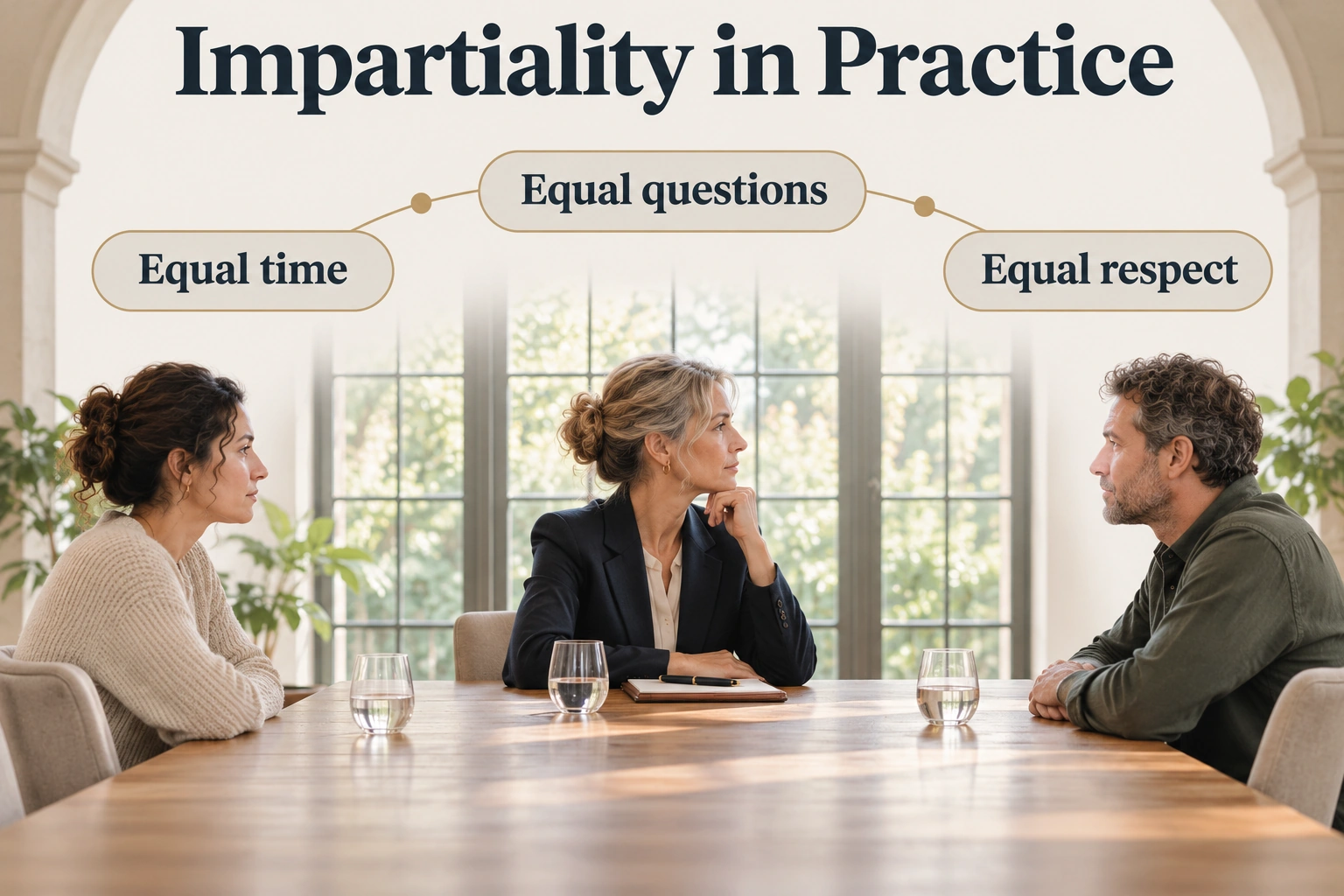
Impartiality is easy to claim and easy to doubt, especially if the other person made the first call or already seems comfortable with the mediator. So it helps to describe it as behaviour, not as a personal quality.
It means each person normally has an individual meeting first and is offered the same opportunity to explain their situation and ask questions. It means the mediator does not privately agree with you that the other person is being unreasonable, even when you badly want to hear it, and does not coach either of you on how to get the better of the other. It also means taking what each of you says seriously, without treating the calmer or more articulate person as the more credible one.
Impartiality does not mean pretending every proposal is equally workable. A mediator can and should test ideas, for either person. How would that work during a school week? What would happen if your hours changed? Those questions are put to both of you in the same spirit, and answering them helps you see for yourselves whether an idea will stand up.
Nor does it mean staying silent about an imbalance. One of you may hold all the financial information, or find it hard to disagree with the other. Making room for both people in those circumstances is part of being fair, and it is the reason a mediator might slow down a discussion, ask for documents to be shared or suggest that someone takes advice before going further.
If you ever feel that we have lost that balance, tell us. We would much prefer you to raise it in the moment than to leave a session feeling unheard. It is a reasonable thing to say to a mediator, and a good one will respond to it without defensiveness.

There is no typical client. The situations below are only examples, and you do not have to fit any of them for it to be worth asking.
Often the priority is getting a routine in place quickly, so that children know where they will be each night. Arrangements made at this stage can be treated as a trial and reviewed as everyone adjusts.
An arrangement that worked well for a long time can stop working when a child changes school, someone moves or a new partner arrives. Coming back to the table at that point is ordinary, and does not mean the original agreement failed.
Some people have no children together but still need to work through a shared home, debts, savings or pensions. Others have settled the arrangements for their children and now want to deal with the finances.
Disagreements over contact with grandchildren, or over caring responsibilities within a family, can also benefit from a structured conversation. Ask us whether your own situation is one that mediation could help with.
A solicitor or someone else may have told you to attend a mediation information meeting before going further, and you may have no wish to sit down with the other person at all. That is fine. An individual meeting explains what mediation is and what your options are, without committing you to it.
You may not be separated at all, only worried about where things are heading, or wondering what your options would be. A short conversation to understand the process does not oblige you to do anything.
A service that believed it suited everyone would not be a trustworthy one. Mediation only works when each person can speak freely and choose for themselves, and there are situations where that is not realistic.
Domestic abuse, coercive or controlling behaviour, threats and fear of the other person are the clearest examples. So are serious concerns about a child’s safety. These issues are considered at the assessment stage and kept under review throughout. Where they are present, mediation may be unsuitable, or may only be possible with particular safeguards such as separate rooms. The decision is made carefully and privately, and nobody should feel they have failed because mediation was not the right route.
There are less dramatic reasons too. A person may be too unwell or too distressed to take part properly at present. Someone may refuse to share financial information that a fair discussion requires, or a matter may need an urgent decision that a series of meetings could not provide in time. In those cases the honest thing is to say so, and to suggest that you seek legal or other specialist advice.
You can also stop. Mediation is voluntary, and either of you may end it at any point. The mediator may also bring it to a close if it no longer seems appropriate. You do not have to justify leaving, and ending mediation does not remove any other option you may have.
If you or a child are at immediate risk, ring the emergency services straight away. Neither mediation nor this website can respond to an emergency.
People do not leave their feelings in the waiting room, and they are not expected to. Anger, grief, embarrassment and relief can all appear in a single session, sometimes in the same person.
A mediator will not tell you to calm down or to put your feelings aside. What the mediator will do is stop those feelings from taking over the process. That may mean pausing when a discussion is heating up, acknowledging that something was hard to hear, or giving each of you a moment alone. Silence is allowed too. Many people need time to think before they answer a difficult question, and it is better to leave room for that than to fill it.
If the emotional weight keeps getting in the way, the mediator might suggest some outside support, such as counselling, alongside mediation. That is a suggestion and never a judgement. Sessions are also not the place to revisit why the relationship ended, unless it directly bears on a decision in front of you. Keeping that boundary is often what makes progress possible.

When a proposal is on the table, ask what a child’s ordinary Tuesday would look like if you adopted it. Then ask the same about a school holiday.
Children are rarely in the room when their parents mediate, yet most of the discussion is about them. Part of a mediator’s job is to keep them present in the conversation: their age, their school routine, the friends they see, how they have coped so far, and what they may be hoping for or worried about.
Bringing that picture into the room often shifts the tone. Two parents can argue for a long time about what is fair to them. It is harder to keep up that argument when the discussion turns to who will take a seven-year-old to swimming on Wednesdays, or how a teenager with exams might feel about moving between homes every few days. The focus moves from winning a point to making a week work.
We do not tell parents which arrangement is best, and there is no formula we apply. Families are too different for that. What we can do is ask about things that tend to get overlooked, such as handovers, birthdays, school events, illness, new partners, phones and contact between visits, along with how you will talk to each other about changes later on.
If you feel your child’s own views should be heard more directly, raise it with the mediator. Whether and how that could happen depends on the child’s age, the agreement of those with parental responsibility and the mediator’s training, so ask what is possible in your case and do not assume either way.
Parents sometimes ask whether an arrangement made in mediation will last. Children grow, and what suits a toddler will not suit a twelve-year-old. That is why many parents build in a date to review what they have decided, so that a change of plan does not have to become a new dispute.

Financial discussions go better when they start with facts. Before weighing up who should have what, you both need a reliable picture of what there is.
That picture includes income, regular outgoings, property, savings, pensions, debts and anything else of value. Each person is normally asked to provide this information with supporting documents, because proposals built on guesses or gaps tend not to survive later scrutiny.
This stage can feel intrusive, and it can be a relief too. For someone who has never seen the household accounts, it may be the first clear view they have had. For the person who managed them, it can end suspicion about what has or has not been disclosed.
Once the picture is clear, the conversation turns to needs and options. Where will each person live? What income will each household have? How long could a particular arrangement last? The mediator can help you test ideas against the figures, but does not advise either of you on whether a proposal is a good deal for you. That is a question for your own solicitor or financial adviser, and we encourage you to ask it before you treat any proposal as settled.
A written summary from mediation is not in itself a legally binding financial settlement. If you reach proposals that you both want to rely on, a solicitor can explain how to make them formal, which may include asking a court to approve them in a consent order.
Mediation works best alongside other kinds of help, not in place of them. This table shows the difference, and where you might want to turn.
| Who | What they can do for you | How the mediator differs |
|---|---|---|
| A solicitor | Advises you alone on your legal position and what a court might do, and can help formalise an agreement | Stays neutral, and can explain general legal information, but does not advise either person on what to accept |
| A financial adviser | Looks at your personal finances, pensions and long-term plans and recommends what to do | Helps you both set out the figures and discuss options, without recommending a product or a course of action |
| A counsellor or therapist | Supports you with the emotional impact of separation, over time and in private | Acknowledges how hard things feel, while keeping sessions focused on practical decisions |
| A court | Can make binding decisions when people cannot agree or when protection is needed | Has no power to make orders or impose a decision |
You may want one or more of these people around you while you mediate. Taking advice between sessions is sensible and is no sign of bad faith, and no one should ask you to set it aside.
Mediation is a joint effort. These two lists set out both sides of it, so that nobody is surprised later on.
Family matters are confusing enough without professional jargon. If a term comes up and you are unsure what it means, ask. A MIAM is a Mediation Information and Assessment Meeting. Shuttle mediation means the mediator moves between people in separate rooms. A consent order is an agreement approved by a court. None of these should be left unexplained.
If you have a disability, a hearing or speech difficulty, childcare constraints, a language need or anything else that could make a meeting harder, please mention it when you call. Raising it early gives us the chance to talk about what could be arranged, and to be honest about anything we cannot offer.
This website does not name individual mediators or list their qualifications. That is a fair thing to ask about before you go ahead, so please ask when you call who would be working with you and what training and accreditation they hold.
No, and that protects you as much as the other person. Calling first simply means you started the conversation. The other person will normally be offered the same chance to meet individually, and will be treated in the same way.
We will not. A mediator does not judge who was to blame or hand down a decision. The focus is on what needs to happen next and what you can both live with.
A mediator can share general information about how things tend to work, but does not advise either of you on your own position. For that you need your own solicitor, and taking advice during mediation is encouraged.
Mediation is private and confidential, with limits that are explained at the start. The main limit concerns safety: a mediator cannot keep quiet about a serious threat to the safety of a child or an adult. Financial information provided in mediation is also treated differently, so ask for the position to be explained before you begin.
Some matters may still be narrowed or settled, even if others are not. Whatever remains, you keep your other options, including taking legal advice or applying to court, and no one will have decided anything on your behalf.
Not at all. Many people come to mediation precisely because they are barely speaking. Separate meetings and shuttle mediation exist for that reason, although safety and willingness still need to be assessed.
It depends on how many issues there are, how complicated they are and how much time you each need between sessions. Some matters need only a few meetings and others need more. We would rather discuss your own circumstances than give you a figure that may not apply.
Often, yes, although it depends on your circumstances, so mention any court dates when you call and take legal advice. An existing order remains in force until it is changed, so ask a solicitor before you depart from it.
Costs vary from case to case, so we do not publish a single price on this website. Ask for a clear explanation of any charges when you call, and before you agree to go ahead.
If what you have read sounds as though it could help, you can ask your questions first and decide afterwards.
0330 010 0028