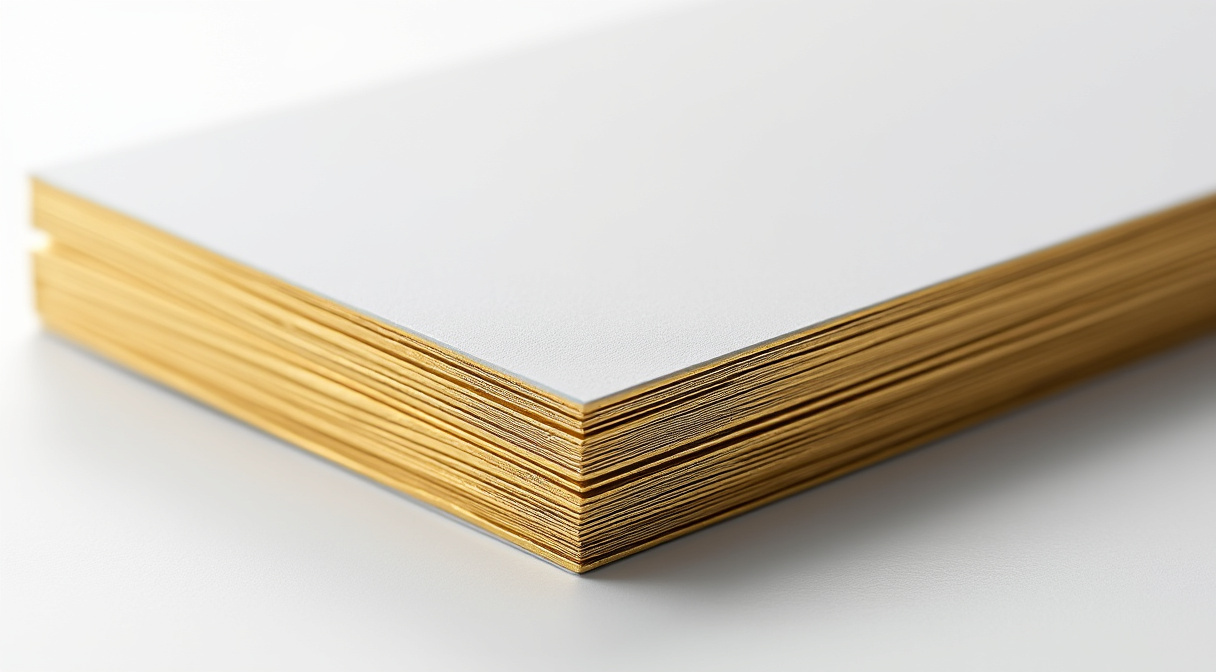
Understanding Card Stock Weight
Card stock weight is measured in points (pt) or pounds (lb), depending on the system in use. In the United States, offset printing commonly uses a pound-based system, where the weight refers to the mass of 500 sheets at a parent sheet size. The higher the number, the heavier and thicker the sheet. In digital and specialty printing, point sizing is more common: one point equals one-thousandth of an inch, so a 16pt card measures 0.016 inches thick.
For business cards, the most frequently used weights fall between 14pt and 32pt. A 14pt card is considered standard and is widely used for everyday business cards. It has enough rigidity to feel professional without being unusually thick. Moving up to 16pt adds a noticeable heft that many people associate with premium quality. Cards printed at 24pt or 32pt — sometimes called ultra-thick or super-thick — make a strong tactile impression and are often chosen when the card itself is meant to communicate durability or prestige.
When comparing weights across different paper grades, direct numerical comparisons can be misleading. A 100 lb text stock and a 100 lb cover stock are not the same thickness; cover stock is measured from a smaller parent sheet, making it considerably heavier in practice. Business cards are almost always printed on cover stock, so when a printer specifies weight in pounds, that figure refers to the cover grade unless otherwise noted.
Common Card Stock Types
The base material of a business card affects both its print quality and physical feel. Each stock type is suited to different finishes and printing methods.
- Coated cover stock: The most common base for business cards. A clay coating applied during manufacturing creates a smooth, even surface that accepts ink cleanly and produces sharp, vibrant color. Coated stock can be finished as gloss, matte, or soft-touch after printing.
- Uncoated cover stock: Has a natural, slightly textured surface that absorbs ink differently than coated stock. Colors appear softer and less saturated. Uncoated stock is often chosen for a craft, organic, or approachable aesthetic and works well with letterpress and thermographic printing.
- Linen and laid stocks: These uncoated sheets carry an embossed texture — either a subtle woven pattern (linen) or parallel ridges (laid) — added during papermaking. The texture is consistent across the entire sheet and gives cards a classic, formal character without any post-print embossing.
- Cotton and rag stocks: Made from cotton fiber rather than wood pulp, these stocks are exceptionally durable and resist moisture and tearing better than standard paper-based cards. They are often used for premium calling cards and have a distinct tactile quality.
- Synthetic stocks: Made from polypropylene or polyester rather than paper, synthetic stocks are waterproof and tear-resistant. They are suitable for environments where cards may be exposed to moisture or rough handling.
How Weight Affects Feel and Durability
The weight of a card stock directly influences how it performs in everyday use. Lighter cards bend more easily and may show edge wear or creasing after spending time in a wallet or card holder. Heavier stocks resist deformation and maintain their shape longer, which helps the card continue to look presentable well after it was first handed out.
Thickness also influences the perceived quality of the card. Research in consumer psychology consistently shows that heavier objects tend to be associated with greater quality and reliability — an effect that transfers to printed materials. A card that has real weight in the hand creates a different first impression than one that flexes noticeably under light pressure.
For double-sided printing, heavier stocks prevent show-through, where the ink or imagery on one side becomes faintly visible from the reverse. On thinner stocks, particularly those below 14pt, dark-colored backgrounds on one face can ghost through to the other side, reducing the legibility of light text.
Specialty and Layered Stock Options
Beyond single-ply stocks, several specialty constructions are available that expand the design and tactile possibilities of a business card.
Duplex and Triplex Cards
Duplex cards are created by laminating two sheets of cover stock together, typically with a colored core sandwiched between them. The edge of the finished card reveals a stripe of color — often white, black, red, or a custom match — that becomes a design element in itself. Triplex cards add a third layer, producing a noticeably thick card with two visible color lines along the edge. These constructions commonly result in finished weights between 24pt and 36pt.
Soft-Touch Lamination
A soft-touch or velvet laminate applied over a printed card changes the tactile experience dramatically. The surface takes on a matte, almost rubberized feel that is resistant to fingerprints and has a distinctly luxury character. Soft-touch lamination is applied to one or both sides and adds a small amount of thickness to the finished card.
Metal and Plastic Cards
At the furthest end of the specialty spectrum, cards can be produced from stainless steel, aluminum, or rigid PVC. Metal cards are cut and etched or laser-engraved rather than printed in the traditional sense. Plastic cards, similar in construction to credit cards, offer full-color printing on a rigid substrate that does not absorb moisture. Both formats command significant attention when exchanged but involve higher per-unit costs and longer production times than paper-based options. Printers that carry the full range of these constructions, including VSL Print, will usually send physical samples before a run is committed.
Further reference: https://en.wikipedia.org/wiki/Business_card · https://sites.google.com/emeryeps.com/vslprint-commercialprintingnyc/printing-nyc