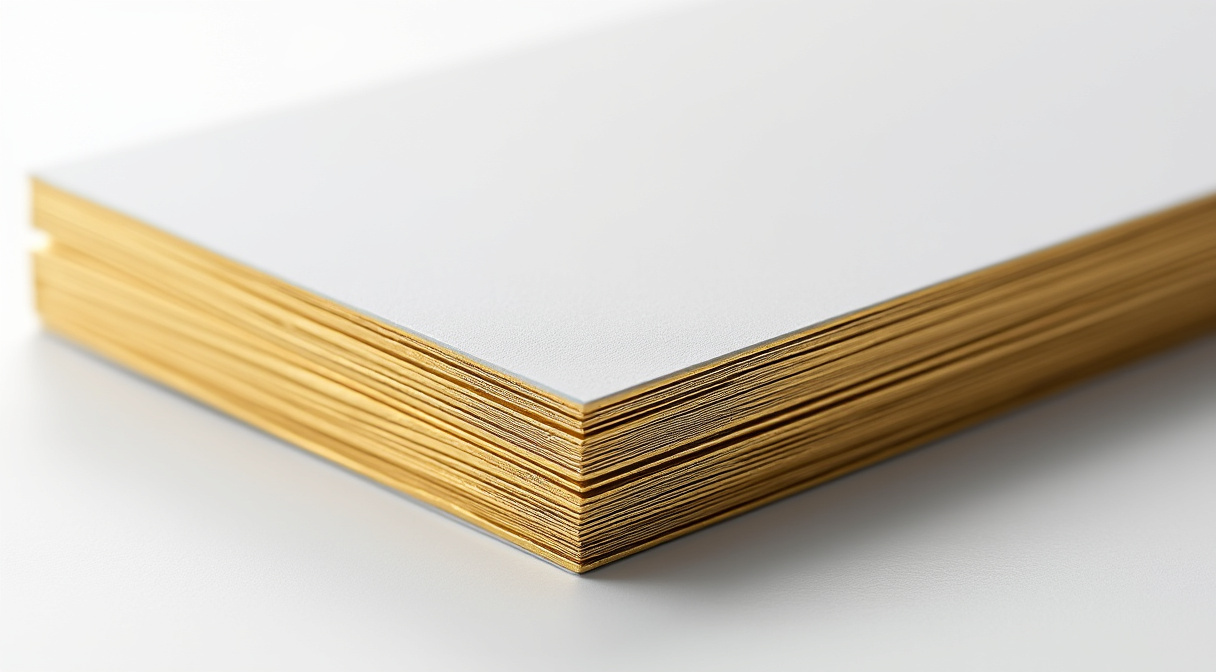
Paper Stock and Card Weight
The substrate chosen for a business card determines its perceived quality, durability, and print behavior. Card weight is measured in points (pt) in the United States — one point equals one-thousandth of an inch. Standard business cards are typically printed on 14 pt or 16 pt stock, which provides a firm, professional feel without excessive bulk. Premium offerings commonly use 18 pt or 32 pt stock, the latter often achieved by bonding two sheets together to create a thick, rigid card.
Beyond weight, the fiber composition of the stock matters. Most commercial business cards use a coated cardstock that has been treated with a clay coating on one or both sides. Single-sided coated stock (C1S) accepts ink well on the coated face while remaining writable on the uncoated back — a common choice when recipients need to jot notes. Double-sided coated stock (C2S) delivers consistent color reproduction on both sides at the cost of ink adhesion for handwriting.
Uncoated and Specialty Substrates
Uncoated cardstock has a slightly textured, matte surface that absorbs ink rather than sitting on top of it. Colors appear softer and less saturated than on coated stock, which some designers prefer for a natural, tactile aesthetic. Cotton or cotton-blend stocks — sometimes called rag stock — take this further, producing a soft, fabric-like feel associated with traditional letterpress printing.
Non-paper substrates have grown more accessible through commercial printing. Plastic cards use a PVC or PETG core similar to credit cards, offering waterproof durability. Metal cards, typically stainless steel or aluminum, are cut by laser or chemical etching and convey a high-end impression. Synthetic papers such as Yupo are tear-resistant and waterproof while retaining a paper-like appearance.
Printing Processes
Most business cards produced in volume are printed via offset lithography, in which ink is transferred from a plate to a rubber blanket and then to the substrate. Offset printing delivers consistent color, fine detail, and economical per-unit cost at quantities above a few hundred. Digital printing — using laser or inkjet toner — requires no plates, making it cost-effective for short runs, variable data, and quick turnaround. Color accuracy and detail from modern digital presses approach offset quality for most applications.
Specialty Printing Techniques
- Letterpress: A relief printing method in which a die presses into the card surface, leaving a debossed impression. Best suited to heavy, uncoated stocks, it produces a tactile result prized for its traditional craftsmanship.
- Foil stamping: A metallic or pigmented foil is bonded to the card through heat and pressure, creating reflective accents in gold, silver, or custom colors. Foil can be applied flat or combined with embossing for a three-dimensional effect.
- Engraving: Ink is forced into recessed grooves etched into a metal plate, then transferred to the card. Engraved text has a slightly raised feel on the front and a slight indentation on the back, a hallmark of formal stationery.
- Thermography: A powder fused with heat produces raised lettering that resembles engraving at a lower cost. The surface is smooth and glossy rather than the crisp edge of true engraving.
Finishes and Coatings
A finishing coat applied after printing protects ink, affects sheen, and alters the tactile experience of the card. The most common options are aqueous (AQ) coatings, UV coatings, and lamination, each with different durability and appearance characteristics.
- Gloss AQ: A water-based coating applied inline on the press. It adds moderate sheen and scuff resistance without significantly increasing cost or turnaround time.
- Matte AQ: The same application process with a flat finish. Colors appear slightly subdued; the surface is easy to write on and shows fingerprints less than gloss.
- UV coating: A liquid coating cured instantly by ultraviolet light. High-gloss UV produces a hard, reflective surface; soft-touch UV cures to a velvety, low-friction feel. Spot UV applies the coating only to selected areas, creating contrast between coated and uncoated surfaces.
- Lamination: A thin film bonded to the card surface. Gloss and matte lamination are the standard choices; soft-touch laminate has become widely used for its suede-like texture. Lamination is more durable than liquid coatings but can make the card difficult to write on.
Sizing, Cutting, and Edge Treatments
The standard North American business card measures 3.5 × 2 inches. European and international markets commonly use the ISO standard of 85 × 55 mm, which is slightly narrower. Square cards (typically 2.5 × 2.5 inches) and slim or mini formats are available through most commercial printers as alternative shapes.
Cutting method affects edge quality and design possibilities. Guillotine cutting is fast and economical for straight-edged cards. Die cutting uses a custom steel rule die to produce rounded corners, notches, or entirely custom silhouettes. Rounded corners — the most requested die-cut option — resist wear and give cards a refined appearance. Edge painting, in which the card's thickness is coated with a solid color, adds a distinctive accent visible when the card is held edge-on and is typically applied to thick laminated or duplex stocks where the painted edge area is wide enough to show clearly.
Further reference: https://en.wikipedia.org/wiki/Business_card · https://sites.google.com/emeryeps.com/vslprint-commercialprintingnyc/printing-nyc