
Why the Provider Matters More Than the Product
Most people approaching Teeth Whitening begin by comparing products — gels, lights, strips, trays — and try to work out which one produces the brightest result. It is an understandable starting point, but it is the wrong question. The active chemistry used in regulated whitening is broadly similar wherever it is legally supplied, because permitted concentrations are set in law rather than by the manufacturer. What varies enormously is the judgement applied to it: who examines your mouth first, who decides whether whitening is appropriate at all, who protects your gums, who records what your teeth actually looked like, and who is accountable if something goes wrong.
Two people can receive gel of an identical concentration and have entirely different experiences, because one had an untreated cavity that nobody looked for and the other did not. The gel cannot tell the difference. Only a clinician who has examined the teeth can.
Registration and Legal Status: Who May Lawfully Whiten Teeth
In the United Kingdom, Teeth Whitening is legally the practice of dentistry. That single fact protects patients more than any other rule in this field, and it is the first thing to establish about any provider. Because whitening is dentistry, it may only be carried out by professionals registered with the General Dental Council: dentists, and dental hygienists or dental therapists working to a dentist's prescription following that dentist's examination and treatment plan.
The prescribing dentist's role is not a formality. It means a dentist has examined the mouth, established that whitening is clinically appropriate, and specified what is to be used and how. What is not permitted is whitening arranged on the basis of a form the patient filled in themselves or a photograph sent by message.
How to verify registration yourself
Verification takes a couple of minutes. Ask for the full name and registration number of the clinician who will actually carry out your treatment, not the name of the practice. Every registrant appears on the General Dental Council's public register, which is searchable by name or number and shows the registrant's professional title and current status. A provider operating properly hands this information over without hesitation. Vagueness, or an answer along the lines of “we are all fully trained”, is meaningful, because training and registration are not the same thing.
Why salon and mobile beauty whitening is unlawful
Whitening offered by beauty salons, mobile beauty technicians, tanning studios and similar settings by people who are not registered dental professionals is a criminal offence in the UK, and prosecutions are brought. The illegality does not depend on the strength of the product or on the outcome; it arises from who is doing it.
Several workarounds are commonly claimed and none of them changes the position. Describing the treatment as cosmetic rather than dental does not exempt it. Nor does using a product marketed as peroxide-free, which either contains a substance that releases peroxide in the mouth or, if it genuinely does not, is unlikely to lighten teeth at all. Nor does handing the patient the applicator to insert themselves. The practical consequence is that an unregistered operator carries no clinical indemnity, keeps no dental records, has no professional body to complain to, and cannot recognise or manage a chemical burn, an allergic reaction, or the untreated decay the treatment has just made painful.
| Aspect | Regulated professional Teeth Whitening | Unregulated whitening |
|---|---|---|
| Who performs it | A GDC-registered dentist, or a hygienist or therapist working to a dentist's prescription | Anyone, including operators with no dental qualification and no registration |
| Pre-treatment assessment | Full examination of teeth, gums, restorations and soft tissues, with radiographs where indicated | Often none, or a self-completed form with no examination of the mouth |
| Product concentration | Within legal limits, from a traceable professional supply chain, with batch and expiry recorded | Unknown, frequently unlabelled, and sometimes far outside legal limits |
| Gum protection | Custom trays or a placed barrier isolating the soft tissues before any gel is applied | Generic trays or no isolation, allowing gel to sit directly on the gums |
| Record keeping | Notes, consent, shade records and photographs retained as part of your dental record | No clinical record, or a booking receipt only |
| Recourse if something goes wrong | Practice complaints procedure, professional regulation and clinical indemnity cover | No professional body, no indemnity, and often no traceable operator afterwards |
Regulated Products and Permitted Concentrations
Whitening gels used in the UK are governed by concentration limits that apply to hydrogen peroxide and to carbamide peroxide, which breaks down to release hydrogen peroxide once in the mouth. Products above the domestic supply threshold may only be used by dental professionals, and the first use of a course must take place in the dental setting. These limits mark the range in which the evidence supports a meaningful colour change alongside a manageable and largely reversible side-effect profile.
What they protect explains why stronger is not a selling point. Peroxide at high concentration is a caustic chemical. On gum tissue it produces a white, blanched burn that later sloughs; on the tooth it drives the sharp, shooting sensitivity people describe as zingers, caused by peroxide passing through enamel and dentine to irritate the pulp. Above a certain point more peroxide does not lift more stain in proportion, because the reaction that breaks down pigment saturates, but the tissue insult continues to climb. Contact time and the number of applications influence the final shade at least as much as raw concentration does, which is why a well-planned course using a legally permitted gel generally reaches the same endpoint with far less disruption.
Traceability matters as much as strength. Professionally supplied gel arrives labelled with the manufacturer, the concentration, a batch number and an expiry date, and is stored as the manufacturer directs, often refrigerated. Peroxide degrades with time and heat, so an out-of-date or badly stored product simply underperforms. Gel decanted into an unmarked syringe cannot be traced, checked or investigated by anyone.
A Genuine Clinical Assessment Before Anything Else
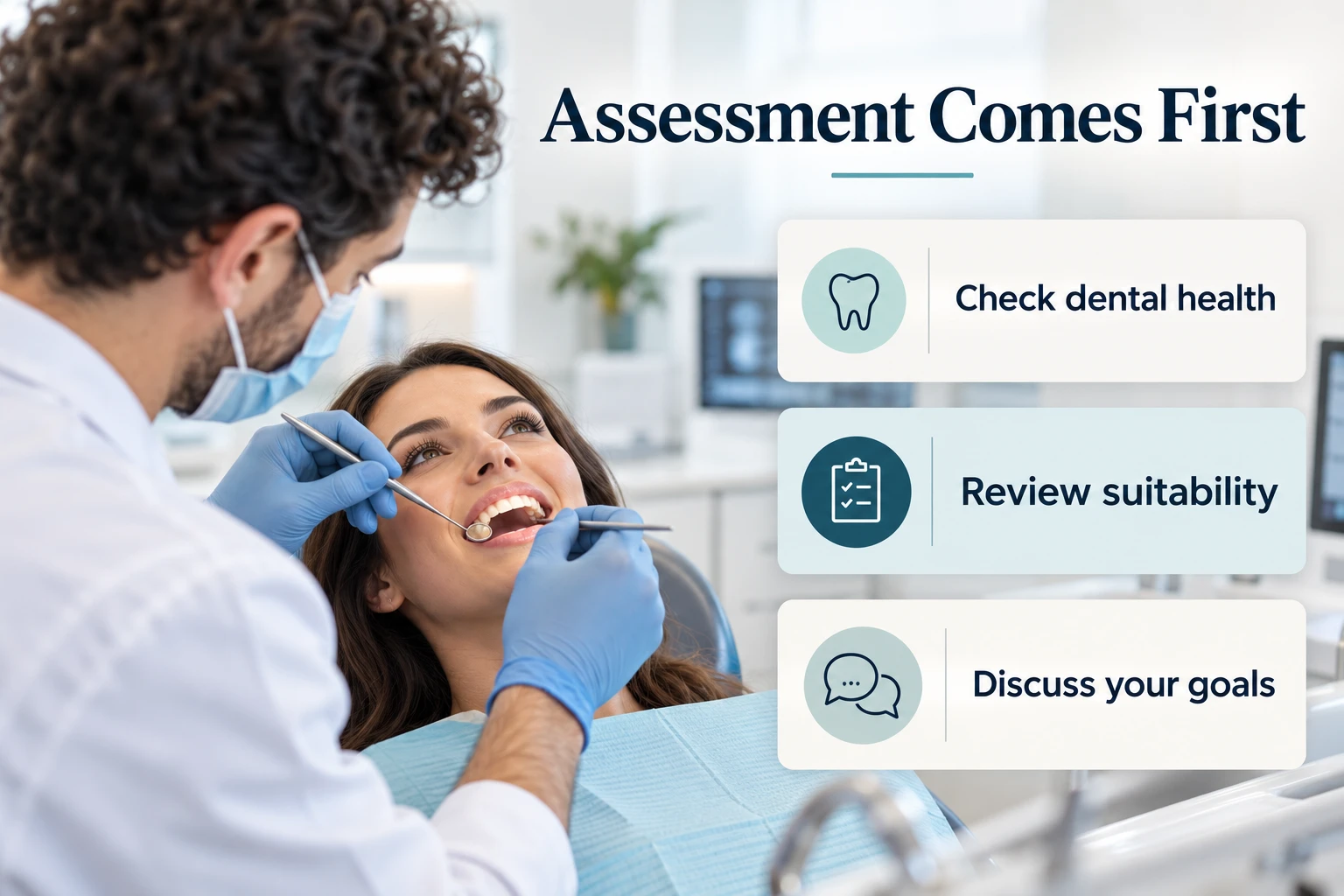
The most valuable part of professional Teeth Whitening happens before any gel is opened. A proper assessment establishes whether whitening is appropriate for you, what it can realistically achieve on your teeth, and what needs attention first. A provider willing to skip it has told you where their priorities lie.
What a thorough pre-treatment examination covers
An adequate assessment looks well beyond the shade of the front teeth. It should include an examination for decay, including between the teeth where it is invisible to you, since peroxide entering a cavity or an open margin reaches the pulp directly and causes severe pain. It should assess the health of the gums, because gel on inflamed or receded tissue is markedly more uncomfortable and exposed root surfaces do not lighten in the way enamel does. Cracks, worn or eroded enamel and exposed dentine all raise sensitivity risk and change how treatment should be paced.
Existing restorations need a careful survey. Crowns, veneers, composite fillings and bonded edges do not respond to peroxide at all, so a white filling in a front tooth that currently blends in may stand out clearly once the surrounding enamel lightens. Knowing this in advance lets you decide whether to plan replacement afterwards, or whether whitening is worth it in your particular case. Radiographs may be needed where there is a history of trauma, deep restorations or symptoms, and a previously root-treated dark tooth requires a different technique entirely.
The assessment should also cover medical history, medication, pregnancy or breastfeeding, age, allergies and habits such as smoking or a heavily pigmented diet. Finally, it should characterise your discolouration: extrinsic surface staining responds well and predictably, while intrinsic changes such as tetracycline banding or fluorosis respond slowly, partially or unevenly. The page on realistic results and what influences them explains how these differences play out.
Why skipping assessment is the clearest red flag
An operator who proceeds without examining the mouth is not saving you time; they are transferring risk onto you. Whitening a mouth with undiagnosed decay, active gum disease or a cracked tooth turns a manageable problem into an acutely painful one. Assessment is also what makes consent meaningful, because without it nobody can tell you what your teeth are likely to do, so any prediction offered is a guess dressed as advice.
Documented Shade Recording, Before and After
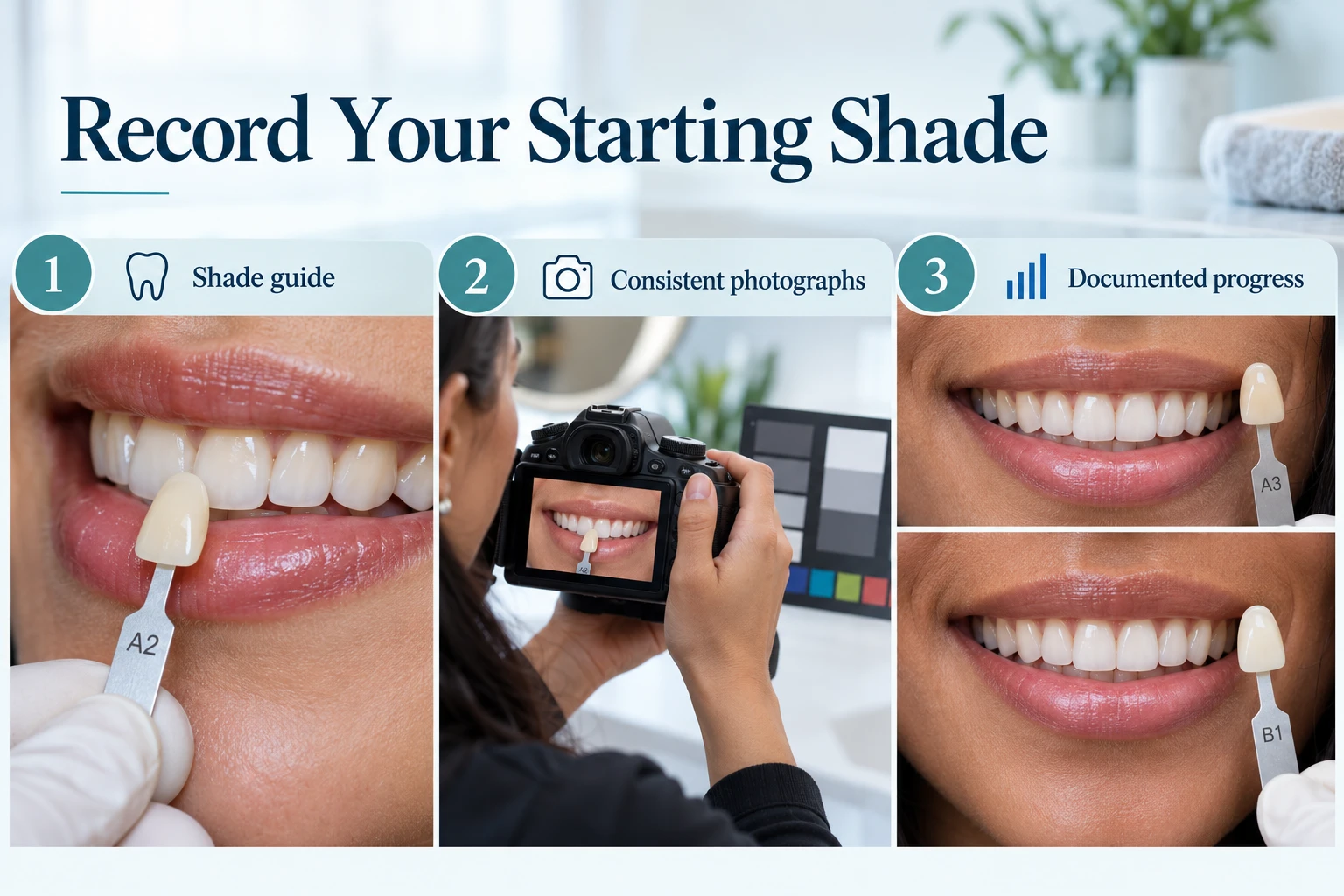
Tooth colour is one of the hardest things to remember accurately. Change happens against a reference you see every day, and the eye adapts to it within hours. This is why many people finish a course of whitening feeling uncertain whether much happened. Proper documentation solves the problem completely, and its presence or absence is one of the most reliable indicators of how carefully a provider works.
What good documentation looks like
The standard approach uses a shade guide: a set of physical tabs in graded colours, arranged from lightest to darkest, held against the teeth to identify the closest match. The starting shade is recorded in the clinical notes and photographed with the matching tab held beside the tooth, so the comparison is captured in the image rather than left to memory. The same method is repeated after treatment and the two records placed side by side.
Consistency is what makes the comparison honest. Photographs should be taken in the same place, with the same lighting and camera settings, at a similar distance and angle, and with the lips retracted the same way. Teeth should be photographed in a comparable state of hydration, because enamel dehydrates during treatment and looks temporarily lighter and more opaque immediately afterwards, an appearance that settles over the following days. A provider who photographs the shade as the trays come out and never again is capturing the flattering moment rather than the durable result.
Why documentation protects you
Custom-Made Trays Versus Stock Trays
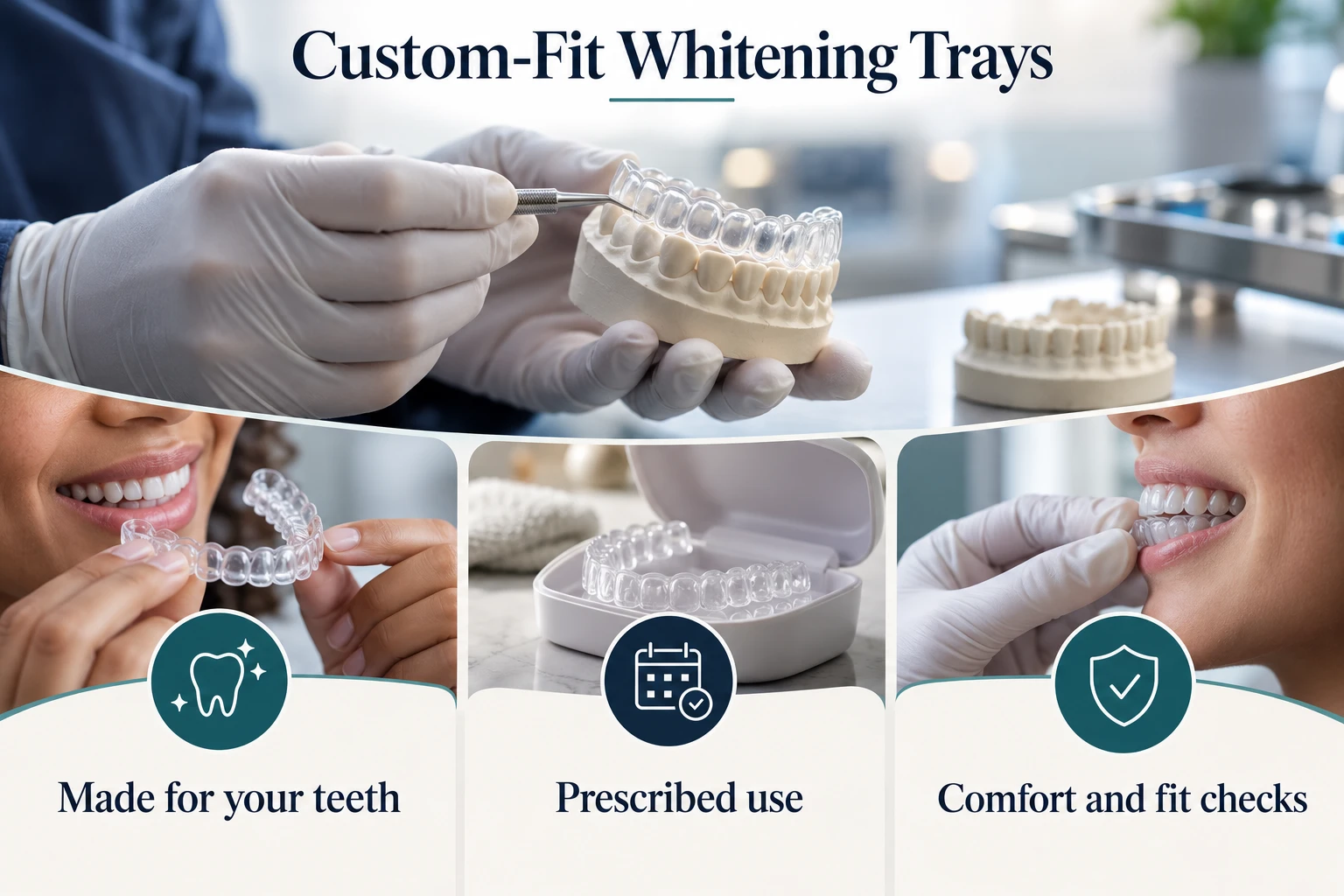
How a custom tray is made and why the fit matters
A custom tray begins with an impression or a digital scan of your own teeth. A model is produced and a thin, flexible tray is formed over it, then trimmed precisely to the gum margin. Small reservoirs may be built in over the visible surfaces of the front teeth so that gel sits where it is needed. The finished tray follows the contour of each tooth, including the spaces between them, and stops at the gum line rather than covering it.
That precision does several things at once. It holds a thin, even film of gel against the whole enamel surface, which is what produces uniform lightening rather than a bright centre with duller edges. It contains the gel, so the active material stays on the teeth for the intended period instead of being diluted by saliva. It keeps peroxide off the gums, which is the main determinant of soft-tissue irritation. And because it is retentive without being tight, it can be worn comfortably for the prescribed period.
The compromises of a stock tray
A stock tray is a generic shape supplied in one or two sizes. Because it is not made for your arch, it sits away from the teeth in some places and presses against them in others. Gel pools where there is space and thins to nothing where there is not, which is precisely how patchy results arise. The margins overlie the gums rather than stopping at them, so gel contacts soft tissue for the entire wear period. Bulky trays also tend to provoke gagging and excess salivation, which encourages people to cut sessions short. A boil-and-bite tray improves retention slightly but still cannot reproduce the interproximal adaptation or the trimmed gum margin of a laboratory-made tray. The overview of professional whitening approaches sets out where each method is typically used.
Treatment Completed in a Single Session Where Appropriate
Efficiency is a legitimate thing to want. Many people can achieve a clearly visible change within one properly planned in-practice appointment, and there is nothing inferior about a result reached that way. What matters is that the efficiency comes from good organisation rather than from cutting steps.
What makes a single-session result possible
Several conditions usually have to be in place. The mouth must already be healthy, with no active decay or gum disease requiring attention first. The discolouration should be predominantly extrinsic or age-related rather than deep and intrinsic. The assessment, consent discussion and shade recording should already be complete, which in practice often means the examination happened at an earlier visit. Enough time must be allocated for several gel applications within the session, with proper isolation of the soft tissues placed and checked before each one. Sensitivity should be anticipated and managed in advance, often with a desensitising agent used beforehand.
When a single session is not appropriate
There are situations where compressing treatment into one visit is the wrong call, and a clinician who says so is demonstrating judgement rather than a lack of capability. Deep intrinsic staining, tetracycline banding and moderate to severe fluorosis usually require a longer, gentler programme over several weeks. A single dark tooth following trauma or root treatment needs a different technique altogether. Patients with pronounced pre-existing sensitivity, extensive exposed root surfaces or marked enamel erosion generally do better with a slower approach that allows recovery between applications. Beware the inverse promise: a guarantee of a specific number of shades in one visit, offered before anyone has examined you, is a marketing position rather than a clinical plan.
Training and Clinical Experience Specific to Whitening
Registration is the necessary foundation, but it is not the whole picture. Whitening is a distinct discipline with its own literature, materials handling, case selection and complication management, and depth of engagement with it varies between clinicians just as it does in any other area of practice.
What to ask about
Useful questions are specific. Ask what postgraduate training the clinician has undertaken in whitening or aesthetic dentistry, and when. Ask how often they carry out whitening and whether it is a regular part of their week. Ask how they approach the harder cases — tetracycline staining, fluorosis, a single dark tooth — because familiarity with the difficult end of the spectrum indicates real engagement. Ask how they manage a patient who develops significant sensitivity partway through, what would make them stop or change the plan, and how they standardise their clinical photographs.
How to interpret the answers
A good answer is concrete and often qualified. It names the type of training rather than gesturing at it, describes how the clinician's approach has changed with experience, and acknowledges the limits of what whitening can do. Clinicians who genuinely know the field are usually the readiest to say that a particular case will only partially improve, because they have seen enough outcomes to predict them.
Aftercare and Maintenance Support

Whitening does not finish when you leave the chair. The days immediately afterwards influence how well the result settles, and the months afterwards determine how long it lasts. A provider whose involvement ends at the point of payment has handed you the least predictable part of the process to manage alone.
Written aftercare rather than verbal advice
Aftercare should be given in writing and taken away with you. Spoken instructions delivered while you are standing up to leave are poorly retained and impossible to check later. Written guidance should explain the dietary window, how to manage sensitivity, what is normal in the first few days, what is not, and how to make contact if you are concerned.
The post-treatment dietary window
For a short period after whitening, enamel is temporarily more receptive to pigment, because the protective pellicle layer has been disturbed and the surface is briefly more porous. Guidance commonly covers coffee, tea, red wine, cola, dark fruits, beetroot, curry, tomato-based and soy-based sauces and coloured mouthwash, alongside a recommendation to avoid smoking. The window is measured in a day or two rather than weeks, but it is the period in which good habits pay the largest dividend.
Desensitising guidance, review and top-ups
A review appointment closes the loop. It allows the settled shade to be recorded once the teeth have rehydrated, any residual sensitivity to be checked, and the outcome to be compared with the documented starting point. It is also the natural moment to discuss maintenance, since a small top-up carried out before noticeable relapse is far less involved than repeating a full course. Guidance on how long results last is set out on the results and expectations page.
Access, Appointment Flexibility and Home-Visit Whitening
Availability across the week
Providers vary considerably in how they schedule. Some offer early morning, evening or weekend appointments; others operate standard hours only. Neither is a mark of quality on its own, but availability that fits your life makes it far more likely that you will attend the assessment, the treatment and the review as planned. It is reasonable to ask what days and times are actually available, and how long each appointment is expected to take. An assessment allocated ten minutes is unlikely to include a thorough examination, and a short in-practice slot cannot include multiple applications with isolation placed and checked each time.
Home-visit whitening: the practicalities and the limits
Whitening carried out in a patient's home is sometimes offered, most often to people whose circumstances make attending a practice difficult. The same legal position applies without modification: the treatment is dentistry, so only a registered dental professional may provide it, and a domiciliary setting creates no exemption. Several practical questions are worth asking of anyone offering it.
- Equipment and lighting. Adequate examination requires proper illumination, suction and a position in which the clinician can see clearly. A domestic sofa and a torch do not meet that standard, and an assessment that cannot be carried out properly should not be treated as having been carried out.
- Hygiene and cross-infection control. Instruments must be sterilised in validated equipment, transported and stored appropriately, and single-use items genuinely used once. Ask how decontamination is handled between visits.
- Emergency handling. A practice has protocols, emergency drugs and colleagues nearby; a home visit has none of these unless they have been planned for. Ask what would happen in the event of an allergic reaction, a soft-tissue burn or sudden severe pain.
- Record keeping and continuity. Notes, consent, shade records and photographs must still be made and retained. Ask where the records are held and how a review would be arranged.
Domiciliary care is a recognised and valuable part of dentistry when it is properly organised. What should give you pause is a home-visit offer that exists to avoid the overheads and scrutiny of a clinical setting rather than to meet a patient's genuine need. General enquiries about how a practice arranges appointments can be raised through its contact information.
Honest, Non-Pressured Advice
What proper consent looks like
Valid consent is a conversation, not a signature. It means being told what is proposed and why, what alternatives exist including doing nothing, what the likely outcome is for your teeth specifically, which side effects are common and which are rare, and what the treatment will cost. It means having time to consider, and being able to change your mind. Consent obtained by presenting a form at the moment treatment is about to begin is consent in name only.
Expectation-setting is part of the same discussion. A careful clinician describes a likely range of improvement rather than a single figure, explains which teeth may respond less well, points out restorations that will not change colour, and is explicit that whitening is not permanent. Where results are illustrated, they should be presented as examples of what has happened for other people rather than as a prediction of what will happen for you.
The absence of pressure
Elective treatment does not need urgency, and manufactured urgency is a warning rather than an offer. Time-limited discounts that expire if you leave without booking, a sense of being processed towards a decision, or reluctance to give you written information to take away all point in the same direction. A provider confident in their work is comfortable with you going away to think, and comfortable with you seeking another opinion.
Perhaps the strongest indicator of all is a willingness to say no. Being told that whitening is not suitable for you at present because gum disease needs treating first, because your discolouration is intrinsic and will respond only partially, or because front-tooth restorations would then mismatch shows clinical judgement operating ahead of commercial interest. A provider for whom every enquirer is suitable is not really assessing anyone.
Transparent, Itemised Costs and a Written Treatment Plan
Cost transparency is not only about the total. It is about knowing what is included, what is not, and what would happen if the plan changed partway through. That information should be given in writing before you commit to anything.
A written treatment plan should identify the clinician who will carry out the treatment, describe the proposed course including the number and likely length of appointments, state what the fee covers and what falls outside it, and set out the terms if treatment is stopped or extended. General information about how whitening is typically costed is set out on the prices and treatment planning page specific figures should always come from the provider in writing.
Items that are frequently unclear and worth confirming individually include whether the initial examination is charged separately, whether trays are included, whether replacement trays carry a fee, whether review appointments are covered, whether top-up gel is part of the price, and what happens if a course has to be paused for treatment discovered during the assessment.
Warning Signs When Choosing a Teeth Whitening Provider
The following signs are each significant enough to justify walking away on their own. Encountering two or more together should end the consideration entirely.
No clinical assessment offered
Treatment arranged from a photograph, a phone call or a self-completed form. Without an examination nobody knows whether whitening is safe for your teeth or what it can achieve.
Registration not shown
The provider will not give the name and registration number of the clinician treating you, deflecting instead with claims of being fully trained and insured.
Non-dental premises
Whitening offered from a salon, studio, retail unit or pop-up stand by someone who is not a registered dental professional. This is unlawful in the UK whatever the product used.
Unbranded or unlabelled gel
Gel in an unmarked syringe with no manufacturer, concentration, batch number or expiry date visible. An untraceable product cannot be checked or investigated if something goes wrong.
Pressure to decide immediately
Discounts that expire if you leave, insistence on booking during the consultation, or reluctance to give you written information to consider at home.
Guaranteed results
A promised number of shades, especially before anyone has examined your teeth. Response varies with the type of staining and cannot honestly be guaranteed.
No aftercare provided
No written instructions, no desensitising guidance and no explanation of the dietary window. The days after treatment influence both comfort and how well the result holds.
No review appointment
No follow-up arranged, no settled shade recorded once the teeth have rehydrated, and no clear route back if something concerns you. Absent reviews often mean absent records.
Questions to Ask Before You Agree to Treatment
These questions are worth asking of any provider, and the quality of the answers usually tells you more than the content. Look for specificity, willingness to qualify, and comfort with being questioned.
- Who exactly will carry out my treatment, and what is their registration number? A good answer gives a full name and number without hesitation, and invites you to check the public register yourself.
- Will a dentist examine my mouth before any whitening takes place? A good answer confirms a full examination, describes what it covers, and explains that a hygienist or therapist would work to that dentist's prescription.
- What product will be used, at what concentration, and can I see the packaging? A good answer names the product, states the concentration, and shows the labelling with batch and expiry details.
- How will my starting shade be recorded, and will I see the before and after? A good answer describes a shade guide and standardised photographs, and confirms both records will be shown to you at the review.
- Are the trays custom-made from an impression or scan of my teeth? A good answer confirms laboratory-made trays trimmed to the gum margin, and explains why generic trays are not used.
- What result is realistic for my teeth specifically, and what will not change? A good answer gives a range rather than a number, identifies restorations that will not lighten, and is candid about intrinsic staining.
- How many appointments will this take and how long is each one? A good answer gives a plan with realistic timings and explains what would cause it to change.
- What are the possible side effects, and how would sensitivity be managed? A good answer separates common temporary effects from rare ones, and describes specific desensitising measures before, during and after.
- What aftercare will I be given, and is it written down? A good answer confirms written instructions covering the dietary window, sensitivity management and how to make contact if you are worried.
- Is a review appointment included, and when would it be? A good answer gives a timeframe, explains that the settled shade is recorded then, and confirms whether it is part of the fee.
- What is the total cost, what is included, and what would I pay for separately later? A good answer is itemised and in writing, covering trays, gel, reviews and any future top-up.
- What would make you advise against whitening for me? A good answer names real contraindications readily, which tells you the clinician is prepared to decline treatment when declining is right.
You do not need to ask all twelve. Three or four, chosen from different parts of the list, will usually reveal how a provider works.
Frequently Asked Questions
Every dentist, dental hygienist and dental therapist practising in the UK must be registered with the General Dental Council, and the register is public and searchable by name and registration number. Ask for the full name and registration number of the clinician who will carry out the treatment, then check it yourself. A provider who will not give you that information should not be treating you.
No. Teeth Whitening is legally the practice of dentistry in the UK, so carrying it out without dental registration is a criminal offence regardless of the product used or how it is described. Salon staff who are not registered dental professionals cannot lawfully whiten teeth, and treatments advertised as cosmetic, non-peroxide or self-applied do not create an exemption.
Yes. A recorded starting shade, ideally with a shade guide tab photographed alongside the teeth in consistent lighting, is what turns an impression of change into documented evidence. It lets you judge the outcome against a fixed reference rather than memory, and gives the clinician a baseline for planning any later top-up.
A custom tray is made from an impression or scan of your own teeth, so it holds a thin, even film of gel against the enamel and stops it flooding onto the gums. A stock tray is a generic shape that fits nobody precisely, which tends to produce uneven contact, patchy lightening at the edges, and gel escaping onto soft tissue where it causes irritation.
Often, but not always. A single in-practice session can produce a visible change where the mouth is already healthy, the staining is mainly on the surface and the assessment has been completed beforehand. Deeper internal discolouration, tetracycline banding and single dark teeth after trauma will usually require a staged programme instead.
Written aftercare should cover the dietary window immediately after treatment, how to manage any temporary sensitivity and which toothpaste or gel to use, what to do if discomfort persists, how to contact the practice if something concerns you, when your review appointment is, and how any future top-up would be planned.
The information on this page is provided for educational purposes only and does not constitute dental or medical advice. It describes general standards of good practice in the United Kingdom and cannot take account of your individual circumstances. Individual suitability and results vary. Always consult a registered dental professional, who can examine your mouth and advise you personally, before making any decision about Teeth Whitening.