What a Teeth Whitening Service Actually Covers
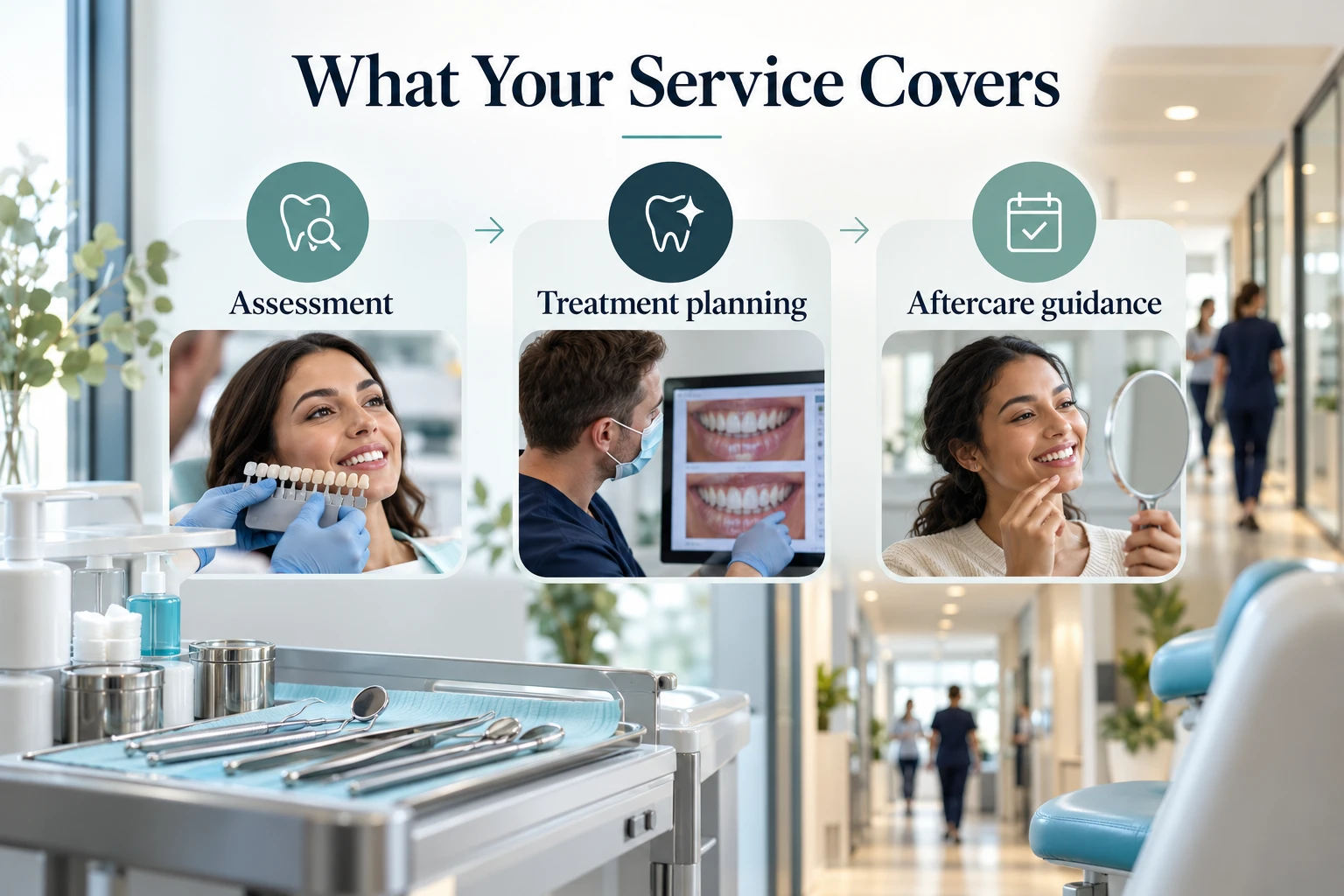
The phrase “Teeth Whitening service” is often used as though it described a single product bought off a shelf. In a dental setting it describes something broader: a short course of clinical care that begins with an examination, continues with a chosen method of applying a peroxide-based gel to the natural tooth surface, and ends with instructions on how to look after the result. The assessment that precedes the gel, the shade record kept alongside it and the aftercare that follows it are all part of the same service, and removing any of them changes both the safety profile and the likely outcome.
Teeth Whitening works on natural tooth tissue rather than on anything added to it. Peroxide breaks down into reactive oxygen species that move through the porous structure of enamel and into the dentine beneath, where they split large, darkly pigmented molecules into smaller, less visibly coloured fragments. Nothing is scraped away and no layer is bleached off. The tooth keeps its shape, its thickness and its natural translucency; what changes is the concentration of pigment sitting inside it.
Because the mechanism is the same across methods, the differences between services are not chemical. They are differences in concentration, contact time, supervision and pace. A high-concentration gel applied by a clinician for a short, closely watched period produces a change in one appointment. A lower-concentration gel worn in a tray at home produces a comparable change over a longer period. Neither is inherently superior; they distribute the same total exposure differently.
Why services are organised by suitability, not by product
Two people can arrive with the same shade of tooth and need entirely different handling. One may have thick, undamaged enamel and staining built up from a decade of strong tea. The other may have thinning enamel, patches of exposed dentine near the gum line, and a history of wincing at cold water. Offering both the same protocol would serve one of them badly.
Assessment and Suitability Screening
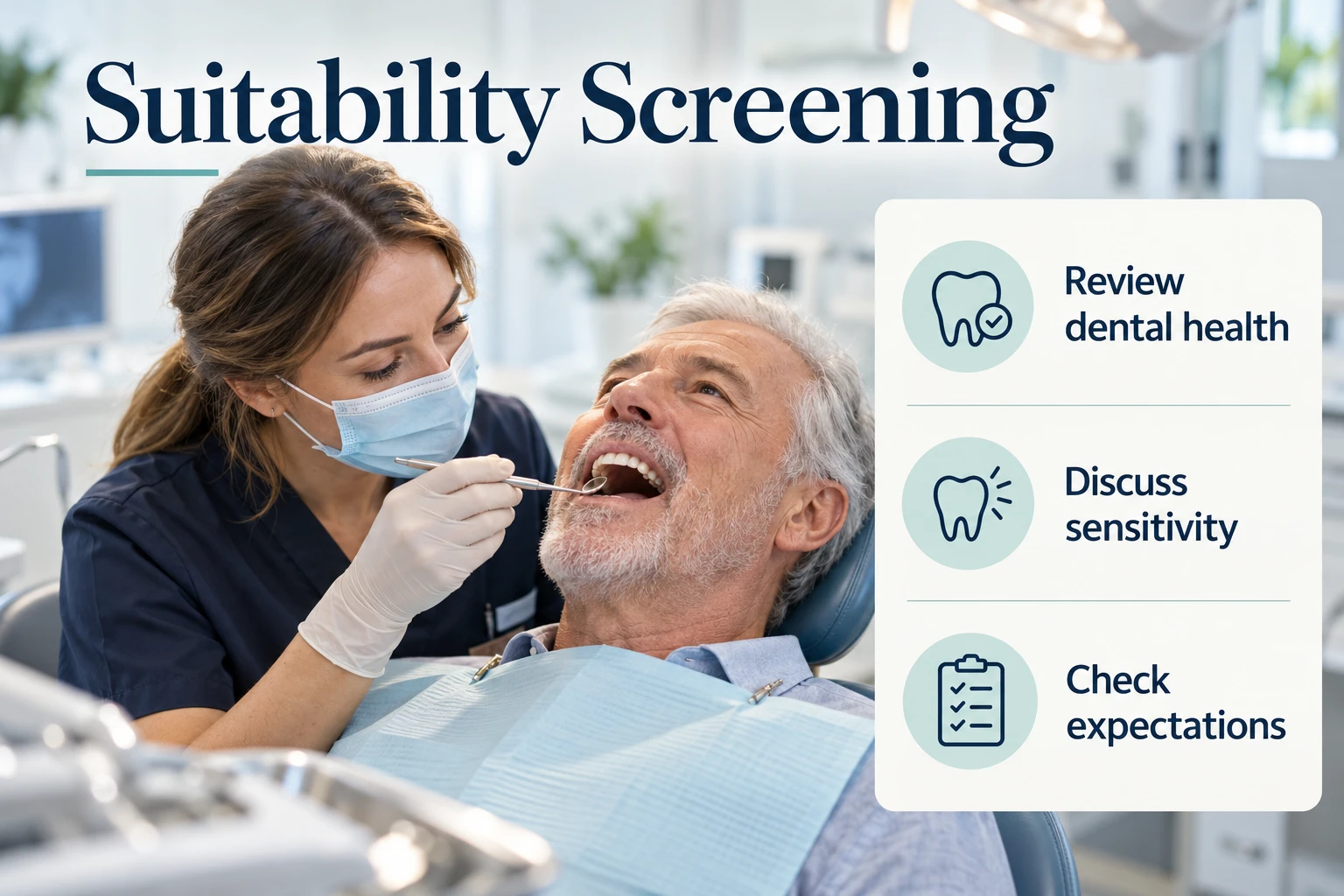
Every legitimate Teeth Whitening service starts in the same place: an examination by a registered dental professional. Whitening gel travels wherever the tooth surface allows it to travel, and a mouth with unaddressed problems provides routes it should not take. The examination establishes whether those routes exist.
What the clinician is looking for
- Decay. A cavity is a breach in the enamel. Gel entering it reaches the inner tooth far more directly than intended, which is uncomfortable at best and can inflame the pulp.
- Gum health. Inflamed or receded tissue is more permeable and more easily irritated, and active gum disease indicates plaque levels that would produce uneven whitening anyway.
- Enamel wear. Thinning from acid erosion or heavy brushing leaves less covering over the dentine, raising the likelihood of sensitivity.
- Cracks and craze lines. Fine fractures channel gel deeper than the surface application suggests, and can whiten differently from the surrounding structure.
- Exposed roots. Root surfaces are covered by cementum rather than enamel. They respond poorly to whitening and are considerably more sensitive.
- Existing restorations. Crowns, veneers, bridges and composite fillings do not change colour, so their visibility determines whether whitening improves the overall appearance or creates a mismatch.
Why treatment is deferred when problems are found
When something is found, whitening is postponed rather than refused outright. Decay is restored, gum inflammation is settled, erosion is investigated and its cause addressed; only then is the shade question revisited. There is a practical reason as well as a safety one. A filling placed after whitening can be matched to the new, lighter shade; one placed before will be matched to the old shade and will stand out once the surrounding teeth lighten.
The assessment also records a starting shade against a standardised guide, so progress can be judged against something other than memory. Photographs may be taken for the same reason. Patients frequently underestimate how much change has occurred, because the shift happens across the whole mouth at once and the eye adapts to it. Examples of treatment outcomes can be viewed in the Teeth Whitening Gallery, which provides a useful visual reference for the type of change whitening can achieve.
In the UK, Teeth Whitening is legally the practice of dentistry. It may only be carried out by registered dental professionals working within permitted peroxide concentrations, and only after a clinical assessment. Any arrangement that skips the examination sits outside that framework. The page on choosing a provider explains what registration means in practice.
In-Practice Teeth Whitening
See teeth whitening in action.Watch on YouTube
In-practice whitening, sometimes called chairside or power whitening, concentrates the process into a single appointment. It is the format most people picture when they think of a Teeth Whitening service, and it is typically planned around an hour of treatment time once the preliminary checks are complete.
The session step by step
- Confirmation of suitability. Even where a full assessment has already taken place, the clinician re-checks the mouth on the day, picking up anything that has changed.
- Isolation and protection. A retractor holds the lips and cheeks clear. A protective barrier — usually a resin painted along the gum margin and set with a curing light — forms a physical seal so that gel cannot reach soft tissue. It takes several minutes and is the single most important comfort measure in the appointment.
- Gel application. The whitening gel is applied evenly across the visible surfaces of the teeth being treated, generally those that show when speaking and smiling.
- Activation. A light or laser unit is positioned in front of the teeth to accelerate the breakdown of the peroxide, so more of the reaction occurs within the appointment window.
- Rest and monitoring. The patient lies still with eyes shielded while the gel works. Sessions are usually divided into timed cycles, with the gel refreshed between them and comfort checked at each change.
- Removal and review. The gel and gum barrier are cleared away, the mouth is rinsed, and the new shade is compared against the record taken at assessment.
What the hour actually feels like
Most of the appointment is uneventful, which is the point. There is no drilling, no injection and no pressure on the teeth; the commonest complaints are a dry mouth from the retractor and stiffness from staying still. Some people experience brief, sharp twinges — often called zingers — which arrive without warning and pass in a second or two. These are worth mentioning as they happen, since the response may be to shorten the next cycle.
A visible change is normally apparent as soon as the barrier comes off. Teeth are slightly dehydrated at the end of a session, which makes them look temporarily lighter and more opaque than they will once they rehydrate. Judging the outcome immediately after the appointment tends to lead to disappointment when the shade settles back a fraction.
Dentist-Prescribed Take-Home Teeth Whitening
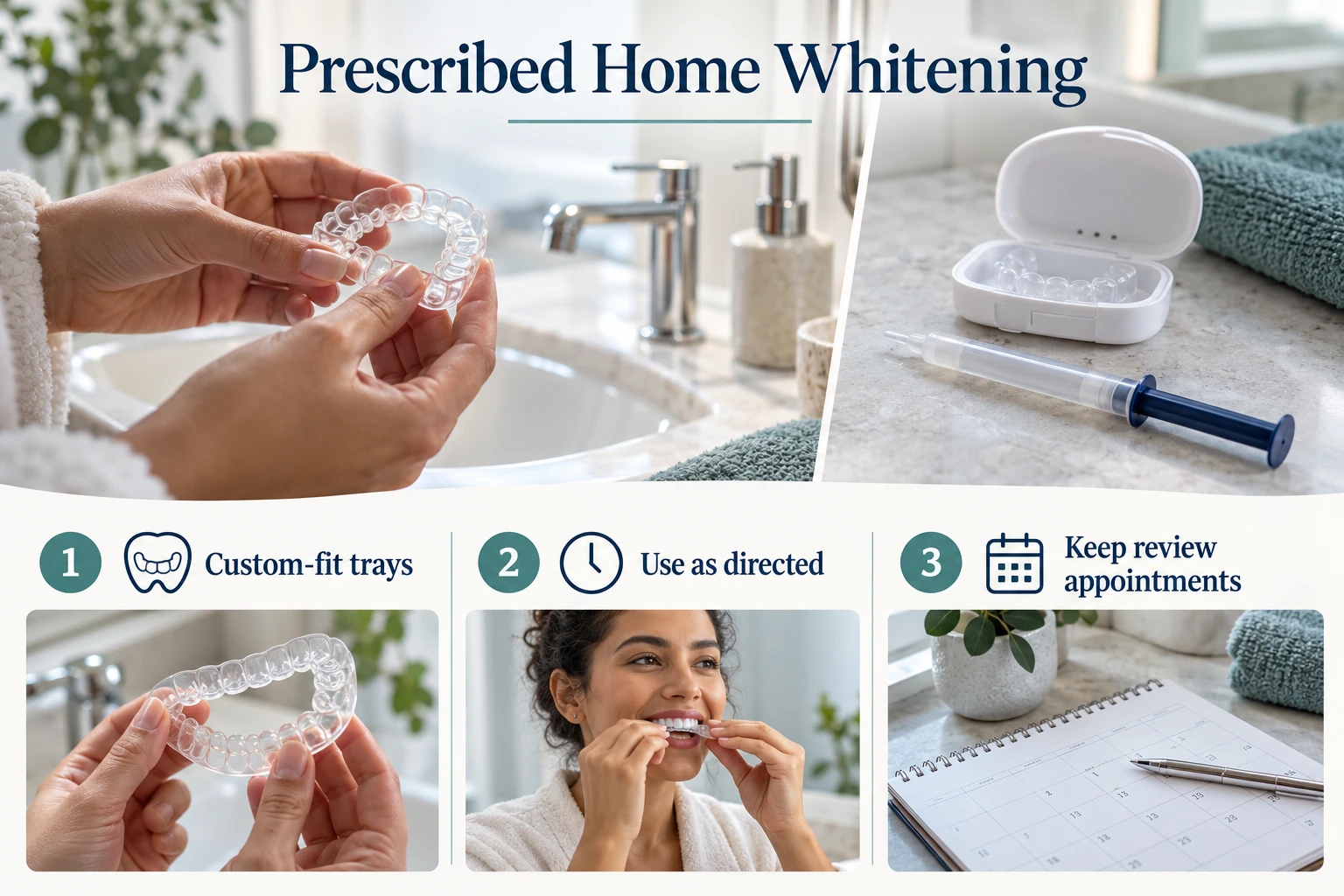
The take-home format uses custom trays made from a scan or impression of the patient's own teeth, filled with a prescribed gel and worn to a schedule set by the clinician. It follows the same assessment as any other whitening service. The distinction from an over-the-counter kit lies in the fit of the tray, the appropriateness of the gel and the supervision behind both.
Why tray fit is the whole point
A custom tray is thin, closely adapted to each tooth, and trimmed to follow the gum line precisely. Many are made with small internal reservoirs so a measured amount of gel sits against the tooth face rather than being squeezed out when the tray is seated. A generic tray is made to an average arch shape, so it holds gel unevenly, leaves some teeth with little contact, and pushes surplus onto the gums where it causes irritation without contributing to the result.
Fit also governs how much saliva reaches the gel, and saliva dilutes peroxide and shortens its working life. A close-fitting tray keeps the gel where it was placed for the intended duration; a loose one lets it wash away long before that, which is one reason people conclude whitening “did not work” when very little active gel actually stayed in contact with the teeth.
Wear schedules and pace of change
Schedules vary with gel concentration. Higher-concentration gels are worn for shorter daytime periods; lower-concentration gels are often worn overnight. Either way the shade shifts gradually, usually becoming noticeable after several applications and continuing over roughly one to three weeks. Patients report back if sensitivity develops, and the usual adjustment is to space applications out rather than abandon the programme.
This gradual pace suits people who would rather their appearance did not change abruptly, and it gives a natural stopping point: the patient stops when they reach a shade they are comfortable with. The trade-off is that it requires consistency at home, and it is the format most likely to stall when someone is busy or travelling.
Combination Teeth Whitening
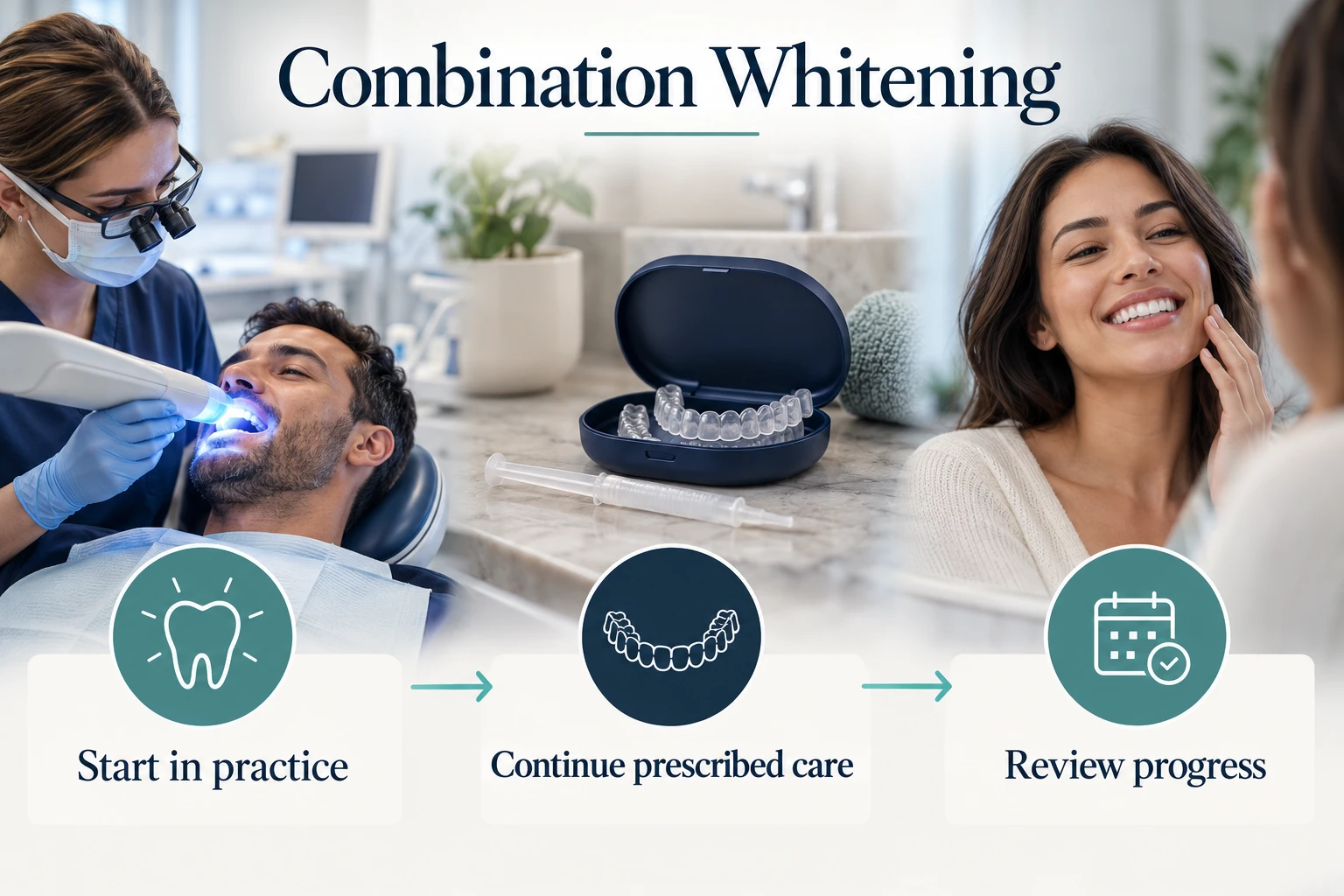
A combination service places an in-practice session at the start and a prescribed take-home programme immediately after it. The clinical appointment produces the initial visible shift; the trays then carry the change further and hold it in place. The two elements are planned together rather than bought separately.
Each format compensates for the other's weakness. The chairside session delivers a substantial change without depending on the patient's routine, removing the risk of a programme fizzling out in its first week. The trays extend exposure over a longer period at a gentler concentration, evening out areas that responded more slowly and allowing the result to be topped up later without a further appointment.
When a combination approach fits best
- When the starting shade is markedly dark and a single session is unlikely to reach the intended point alone.
- When staining is uneven across the arch, so some teeth need longer contact than others.
- When someone expects to need periodic refreshers — regular tea, coffee or tobacco use makes this likely — and would rather have trays already made.
- When a person wants the reassurance of a supervised first session before managing anything themselves.
Comparing the three service formats
| Feature | In-practice | Take-home trays | Combination |
|---|---|---|---|
| Session length | About one hour in a single visit | Short fitting visit, then daily wear at home | One clinical hour, then a home programme |
| Pace of change | Visible at the end of the appointment | Gradual, typically over one to three weeks | Immediate start, then continued refinement |
| Supervision | Continuous; a clinician present throughout | Prescribed and reviewed, but self-administered | Direct in session, reviewed afterwards |
| Control over intensity | Clinician-led, adjusted between cycles | Patient-led within prescribed limits | Shared, with boundaries set at handover |
| Sensitivity management | Handled live; cycles shortened or stopped | Handled by spacing out applications | Both routes available |
| Best suited to | People wanting one supervised appointment | People who prefer gradual change and control | Darker or uneven staining, and likely top-ups |
Teeth Whitening for Young Adults
Younger adults form one of the clearest suitability groups, and their reasons for seeking whitening differ from those of older patients. The staining is usually mild and recent rather than decades deep, and the motivation is often social: photographs, interviews, and the everyday awareness of how a smile looks in close conversation. More information about this suitability group can be found in our guide to Teeth Whitening for Young Adults.
Confidence and the habit effect
A brighter, cleaner-looking smile makes many people less guarded in photographs and less inclined to cover their mouth when laughing. That is a modest change, but it is the one most young adults describe. There is a second, more durable effect: having invested attention in the appearance of their teeth, people often become more consistent about looking after them. Brushing becomes less perfunctory, flossing starts happening, check-ups get made. The whitening itself does not improve oral health, but the behaviour it prompts frequently does.
Enamel maturity and why age matters
Enamel continues to mineralise after a tooth erupts, a process called post-eruptive maturation. Newly erupted permanent teeth are more porous than the same teeth will be a few years later, so peroxide passes through them more readily and sensitivity is more likely. Pulp chambers are also relatively larger in younger teeth, placing the nerve closer to the outer surface.
The position on under-18s in the UK
UK regulations restrict the supply and use of tooth whitening products containing or releasing more than 0.1% hydrogen peroxide to people aged 18 and over. The single exception is where a dental practitioner uses such a product to treat disease — addressing a discoloured tooth arising from a clinical problem rather than a cosmetic preference. Cosmetic whitening for a healthy under-18 mouth falls outside what a registered professional may provide.
Younger teenagers asking about whitening are therefore advised to wait, and to spend the intervening period on the things that genuinely influence tooth colour: reducing frequent exposure to staining and acidic drinks, brushing properly, and completing any orthodontic treatment. Whitening after braces are removed is common, partly because the teeth are finally in their settled positions and partly because the whole surface can then be treated evenly.
Teeth Whitening for Tea and Coffee Drinkers

Tea and coffee drinkers are probably the largest single group seeking whitening in the UK, and among the most responsive, because the staining involved sits where whitening gel works best. For people whose smile has gradually become darker through regular tea or coffee consumption, understanding the cause of the staining is useful when deciding whether whitening is appropriate. Further guidance is available in our Teeth Whitening for Tea and Coffee Drinkers information.
Tannins, chromogens and the pellicle
Tea and coffee both contain tannins, a family of organic compounds that bind readily to proteins. Within minutes of brushing, a thin protein film called the acquired pellicle re-forms over the enamel from components of saliva. Tannins attach to that film and help pigmented molecules, known as chromogens, adhere alongside them. Each cup deposits a fresh, almost imperceptible layer, and over years those layers accumulate into the yellow or brownish cast most people eventually notice in a photograph rather than a mirror.
Frequency matters more than volume. One large cup in the morning gives the mouth the rest of the day to clear. Six cups spread from breakfast to evening keep the tooth surface in near-continuous contact with tannins, so the pellicle never has an uninterrupted stretch in which to stay clean. Black tea tends to stain more heavily than coffee for the same volume, which surprises people; the tannin content is the reason.
Why this staining type responds well
Because tannin staining accumulates in and just beneath the outer surface, peroxide reaches it easily. A whitening service will usually restore a good part of the tooth's original shade and lighten it by several shades from the recorded starting point. It does not make the tooth whiter than it ever was; it removes accumulated pigment to reveal what was underneath, a distinction the results page discusses in more detail.
Realistic maintenance
Brushing or rinsing after every cup would be effective and is, for most people, impractical at work or when out. More sustainable measures include:
- Moderating frequency rather than quantity — consolidating several small cups into fewer larger ones reduces the number of separate staining episodes.
- Drinking through a straw where the setting allows, so liquid bypasses the front teeth and the areas that show when smiling.
- Rinsing with plain water afterwards, which requires no equipment and clears much of the residue.
- Brushing later rather than immediately, since a wait of around half an hour avoids scrubbing enamel just exposed to acidity.
Nobody is being asked to give up tea. The point is that a whitening result and a six-cup-a-day habit will need periodic refreshing, and it is easier to plan for that than to be disappointed by it.
Teeth Whitening for Smokers and Tobacco Users
Tobacco staining behaves differently from dietary staining and is harder to shift. Tar is a sticky, dark residue that adheres tenaciously to enamel and works into surface irregularities. Nicotine is colourless in itself but yellows on contact with oxygen, and deposits alongside the tar. The combination produces a brown or greyish discolouration, often heaviest on the inner surfaces of the lower front teeth and around the gum margins.
Because these deposits are denser and penetrate further than tannin films, they resist peroxide more stubbornly. A whitening service can still make a clear difference, but a smoker may need longer contact time, a combination approach rather than a single session, or more than one course to reach a comparable endpoint. Very heavy staining can include a hardened tar layer that requires professional cleaning before whitening gel can reach the enamel at all.
Why continued smoking shortens the result
Whitening removes existing pigment; it does nothing to prevent new pigment arriving. Someone who continues to smoke at the same rate begins re-depositing tar from the day treatment ends, and the whitened surface — briefly more porous — is particularly receptive during the first day or two. This is why aftercare advice for smokers is emphatic about avoiding tobacco during that initial window even if they do not intend to stop altogether.
There is also a health dimension a clinician will raise regardless of the cosmetic conversation. Smoking is associated with gum disease, delayed healing and oral cancer, and gum disease itself can rule out whitening until it is under control. Vaping is sometimes assumed to be stain-free; it deposits less than combustible tobacco, but flavourings and residues can still contribute to discolouration and to dry mouth, which reduces the natural cleansing effect of saliva.
Anyone using tobacco gets the most out of whitening by pairing it with a hygiene appointment beforehand and, where feasible, a reduction afterwards. The result is not conditional on stopping, but its longevity is closely tied to what happens next.
Teeth Whitening for Sensitive Teeth
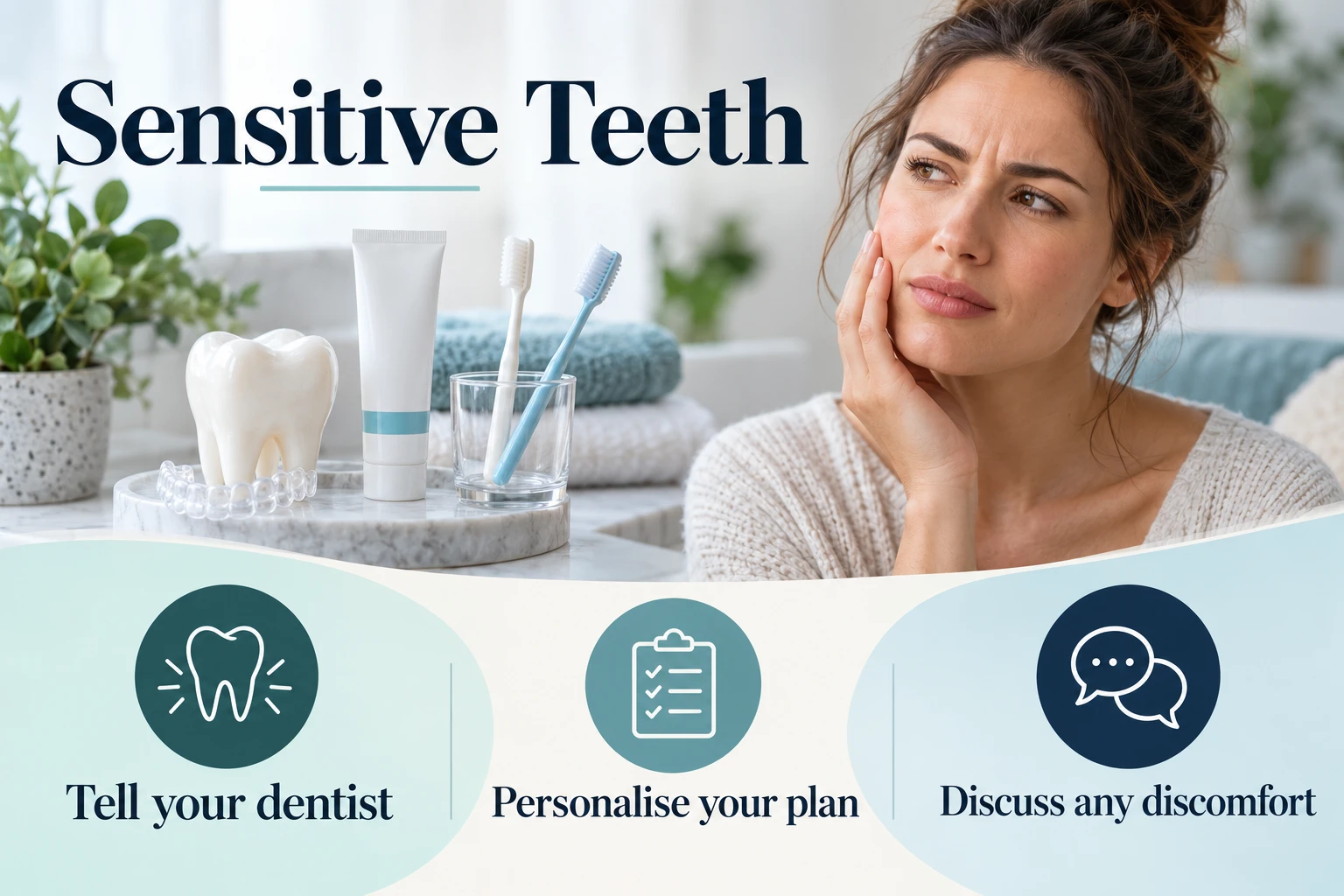
Sensitivity is the reason most often given for avoiding whitening altogether. People who already flinch at cold drinks reasonably assume a chemical process applied directly to their teeth will be worse. In many cases it can be managed, provided the sensitivity is understood beforehand rather than discovered midway through.
What causes the sensitivity in the first place
A tooth is built in layers. The outer coating is enamel: hard, translucent, containing no nerves. Beneath it lies dentine, a softer yellowish tissue that makes up the bulk of the tooth and is threaded with microscopic tubules running inward toward the pulp, where the nerve sits. While the enamel coating is intact, the dentine is insulated and the tubules are sealed off from the outside world.
Sensitivity develops as that enamel coating thins or wears away and the dentine underneath is exposed. Acid erosion from fizzy drinks, citrus or reflux dissolves enamel gradually; abrasive or forceful brushing wears it mechanically; grinding flattens it; gum recession exposes root surfaces never covered by enamel to begin with. Once dentine is open, fluid within the tubules moves in response to temperature, pressure or chemical stimuli, and that movement is what the nerve registers as a sharp, short-lived pain.
This is also why whitening can provoke discomfort. Peroxide reaches the pulp more easily where dentine is exposed, producing a temporary inflammatory response. It is transient and does not indicate damage, but it is unpleasant and in many cases avoidable through preparation.
How the service is adapted
- Investigate first. Sensitivity is a symptom, not a diagnosis. A cracked tooth, decay, a failing filling or recession each need different handling, and whitening over an undiagnosed cause is unwise.
- Desensitising preparation. Using a toothpaste containing potassium nitrate or a similar agent before treatment allows nerve response to settle. Fluoride varnish or in-surgery desensitising agents may also be applied.
- Lower concentration, longer programme. Spreading the same total exposure across a gentler, more extended course reduces the intensity of any single episode.
- Shorter contact cycles. In a clinical session, cycles are cut short and the response checked between each rather than pushing through a standard timetable.
- A calm, unhurried appointment. Adequate time lets the clinician stop and reassess, and patients who know they can pause tolerate the process considerably better.
Setting expectations
A change is still visible at the end of the session; it may simply be reached more cautiously and in smaller increments. Any sensitivity that does arise typically subsides within a day or two. What a service will not do is make an already sensitive tooth less sensitive in the long run — that requires addressing the underlying enamel loss or recession, which is a separate conversation.
Teeth Whitening for Maturing and Ageing Smiles
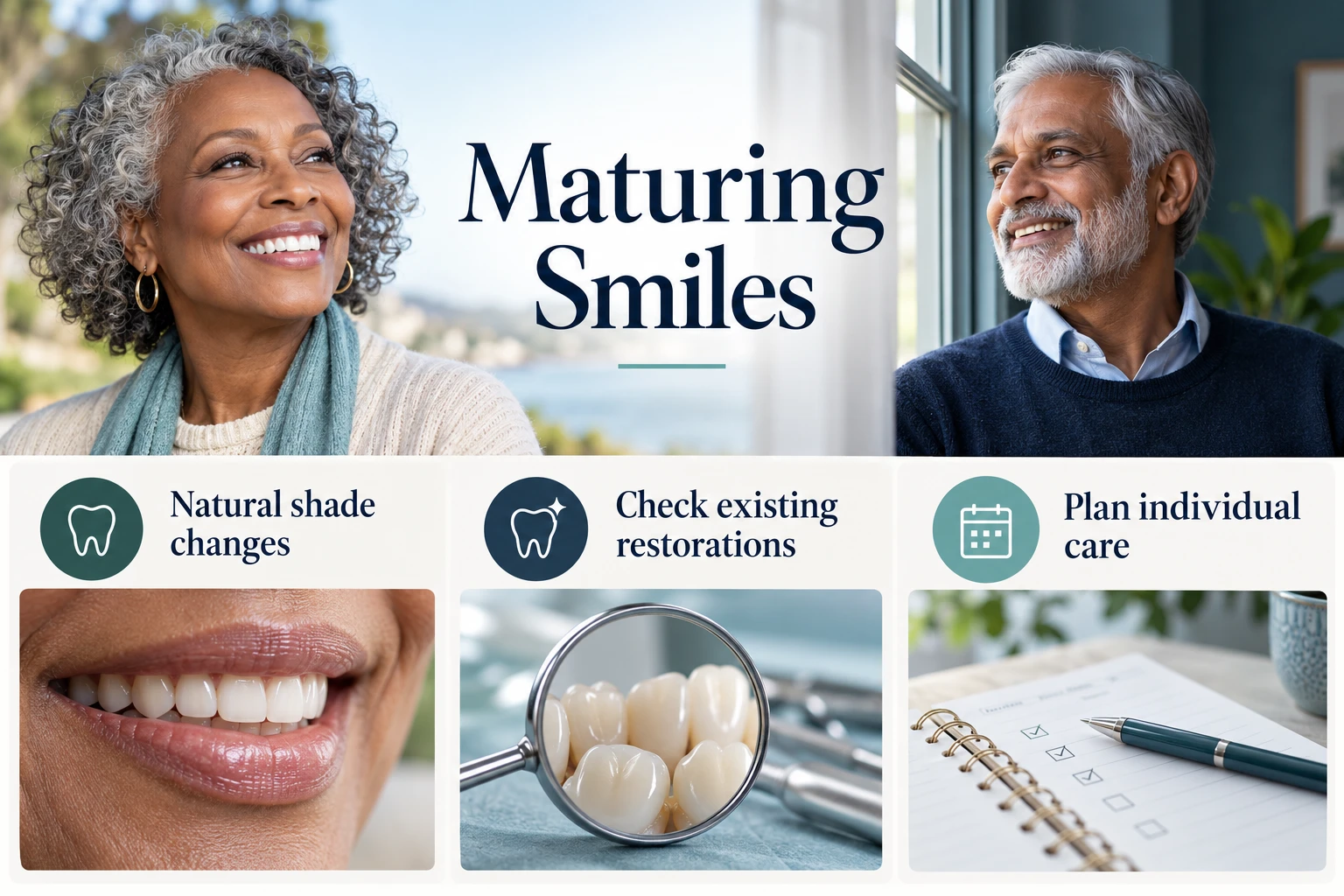
Tooth colour changes with age in every mouth, regardless of diet or hygiene, and it does so through two mechanisms working in the same direction at once.
The first is enamel thinning. Decades of chewing, brushing and dietary acid gradually reduce the thickness of the outer layer, and because enamel is translucent rather than opaque, thinning it lets more of what lies beneath show through. The second is dentine darkening: throughout life the tooth lays down secondary dentine on the inner surface of the pulp chamber, and existing dentine becomes more mineralised and yellower. A thinner outer layer therefore sits over an increasingly yellow core — a compounding effect that brushing cannot address, because none of it is a surface deposit.
What responds and what does not
Peroxide acts within dentine as well as enamel, so the darkening component is genuinely reachable and mature teeth often whiten well. The limitation is that lost enamel does not come back. A tooth that has become thin and translucent at its biting edge will still look slightly grey or transparent there afterwards, because that appearance comes from an absence of tissue rather than from pigment.
Older mouths are also more likely to carry a history of dental work. Crowns placed twenty years ago, composite fillings on front teeth, and root-filled teeth that have darkened from within all behave differently from the natural teeth around them. A root-filled tooth may need a different technique applied from inside the tooth, which is a distinct procedure rather than part of a standard whitening service. The assessment is where these variables are mapped.
What a Whitening Service Does Not Treat
Clarity about limits prevents most disappointment. A Teeth Whitening service changes the colour of natural tooth tissue. It is not a repair, a cleaning or a cosmetic rebuild, and substitutes for none of them.
Decay
A cavity is lost tooth structure. Whitening does not arrest, fill or disguise it, and gel on a decayed tooth risks pulp irritation. Restoration comes first.
Gum disease
Inflammation, bleeding and pocketing are bacterial problems needing hygiene treatment. Whitening does nothing for them, and irritated tissue tolerates the process poorly.
Structural damage
Chips, cracks, worn edges and erosion involve missing or fractured tissue. A lighter shade may make them marginally less conspicuous, but the defect remains.
Restorations
Crowns, veneers, bridges, dentures and composite fillings hold the shade they were made in, so whitening around them can leave them looking darker by comparison.
Alignment and shape
Crowding, spacing, rotation and uneven edges are orthodontic or restorative concerns. Colour change alters none of them.
Plaque and tartar
Hardened deposits block gel from reaching enamel and produce patchy results. They are removed by a hygienist beforehand, not by the whitening process itself.
Certain kinds of intrinsic discolouration also respond only partially. Marks from tetracycline exposure during tooth development, mottled areas from dental fluorosis, and single teeth darkened by past trauma each behave unpredictably and may need a much longer programme or a different approach. None of this makes whitening pointless in those situations; it makes an honest conversation at assessment essential.
Preparing for an Appointment and Immediate Aftercare

What happens on either side of the treatment affects both the result and the comfort of getting there.
Before the appointment
A professional clean is usually arranged first. Plaque and calculus act as a barrier, and gel applied over them whitens unevenly, leaving patches where deposits sat. Removing them gives the peroxide an even surface to work across and makes the recorded starting shade a more honest baseline. Where sensitivity is anticipated, a desensitising toothpaste is often started a week or two ahead. Patients are also asked to mention any medication, pregnancy, breastfeeding or recent dental work, since some of these lead to postponement.
The white diet window
For roughly the first 24 to 48 hours the enamel is temporarily more porous and the protective pellicle has been stripped away, so the tooth surface picks up pigment far more readily than usual. The standard guidance is to avoid anything that would stain a white shirt: coffee, tea, red wine, cola, curry, tomato sauces, soy sauce, beetroot, berries and highly coloured sweets, along with tobacco. Chicken, fish, rice, plain pasta, potatoes, white cheese, milk and water are the usual replacements. It is a short window and it does more for the durability of the result than almost anything else.
Managing sensitivity afterwards
If teeth feel tender, a desensitising toothpaste applied gently and left rather than immediately rinsed away is the usual first response, and very hot or very cold foods are best avoided for a day or two. Sensitivity that persists beyond a few days, or that is localised to one tooth rather than felt generally, warrants a call to the practice, as it may point to something the assessment did not reveal.
Follow-up and longer-term care
A review lets the clinician record the settled shade once the teeth have rehydrated, check the gums and discuss maintenance. Where trays were made, they are kept for occasional short refreshers rather than continuous use. Routine check-ups and hygiene visits continue as normal, and are the main reason a result holds up over time. General questions about arranging any of this are handled through the contact page, and the site's wider guidance sits on the home page.
Frequently Asked Questions
How long does a Teeth Whitening service take from start to finish?
An in-practice session is usually planned around an hour of chair time, preceded by assessment at an earlier visit. A take-home programme starts with a short appointment for a scan or impressions, a wait while the trays are made, then daily wear over roughly one to three weeks. Add the professional clean beforehand and a review afterwards, and most people are looking at a few weeks from first appointment to final review rather than a single afternoon.
Does Teeth Whitening damage enamel?
Gels used within the concentrations permitted for registered dental professionals are formulated to pass through enamel and act on the pigment held within the tooth, not to dissolve tooth structure. Enamel does become transiently more porous immediately afterwards, which is why the aftercare window exists, but it remineralises from saliva over a day or two. The genuine risks lie elsewhere: unsupervised use of products of unknown strength, ill-fitting trays that push gel onto gums, and repeated top-ups without assessment.
Will crowns, veneers and white fillings whiten too?
No. Peroxide changes the colour of natural tooth tissue only; ceramic and composite materials retain the shade they were made in. A filling or crown on a front tooth that currently blends in may therefore look noticeably darker once the teeth around it lighten. The clinician raises this at assessment, and the options are to accept the difference, to replace the restoration afterwards so it can be matched to the new shade, or to reconsider whitening in that particular mouth.
Can people with sensitive teeth have Teeth Whitening?
Frequently yes, but the cause should be examined first, because a cracked tooth or an area of decay needs treating rather than working around. Where the cause is enamel thinning or gum recession, the adaptations are well established: desensitising preparation for a week or two beforehand, a lower gel concentration, shorter contact cycles, and a longer overall programme so no single application is intense. Sessions are kept unhurried so the process can pause the moment discomfort arises.
Is Teeth Whitening available to under-18s in the UK?
Products containing or releasing more than 0.1% hydrogen peroxide may only be supplied to people aged 18 and over, the exception being where a dental practitioner uses such a product to treat disease. There are biological reasons behind the rule as well as legal ones: enamel in newly erupted teeth is more porous and the pulp sits closer to the surface, so younger teeth are more prone to sensitivity. Younger patients are advised to wait, complete any orthodontic treatment, and revisit the question afterwards.
How long do the results of a Teeth Whitening service last?
There is no fixed lifespan, and any specific figure should be treated with caution. Results fade as new pigment accumulates, so the timescale is governed by habits: several cups of tea or coffee daily, red wine, or continued smoking will bring noticeable change sooner than a diet low in staining foods. Hygiene matters too, since plaque holds stain. Where trays have been made, an occasional short refresher manages this without repeating the whole programme.
Everything set out above is general information about how Teeth Whitening services are structured and who they are typically adapted for. It is educational material, not dental advice, and it cannot account for the condition of any particular mouth. Suitability, method, concentration and timing are decisions for a registered dental professional who has examined you and knows your history.