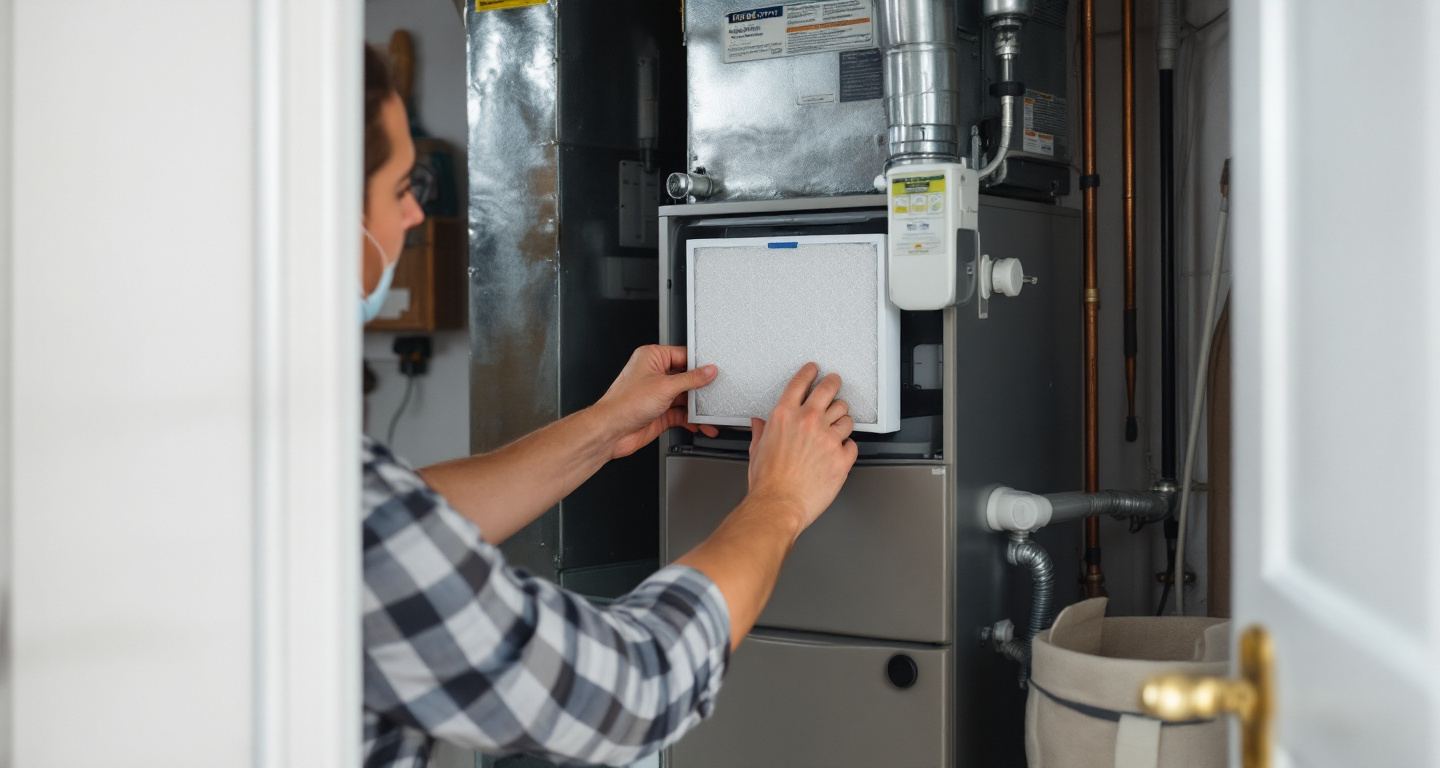
Filters, Airflow, and Indoor Air Quality: The Single Most Impactful Thing You Can Do
Your HVAC filter is doing two jobs at once, and most homeowners only think about one of them. The obvious job is keeping your indoor air cleaner. The less obvious but equally important job is protecting the mechanical heart of your heating and cooling system. When that filter gets clogged — and in the Pacific Northwest, it will get clogged faster than the packaging suggests — it starts failing at both.
What a Filter Actually Does, and Why It Matters Here
Air has to move through your system constantly for it to function. The blower pulls return air in, pushes it across the heat exchanger or coil, and distributes conditioned air back through your home. The filter sits in the path of that return air and catches particles before they reach the equipment.
When the filter is clean, air moves freely. The blower runs efficiently, the coil stays clean, and the heat exchanger operates at the temperatures it was designed for. When the filter loads up with debris, the system has to work harder to pull the same volume of air. Static pressure rises, airflow drops, and equipment starts operating outside its design parameters. Over time, a restricted coil ices up, a heat exchanger runs hotter than it should, and the blower motor strains continuously.
In the Pacific Northwest, this cycle happens faster than in most parts of the country. The Willamette Valley carries one of the higher tree pollen loads in the nation, with a season that starts in late winter and doesn't fully wind down until summer. On top of that, wildfire smoke has become a recurring summer and fall reality — not just local fires, but particulates drifting from hundreds of miles away. Fine smoke particles migrate indoors and load your filter in ways that pollen alone doesn't. Smoke season and pollen season now overlap enough in the Portland metro that a filter changed in spring can look like it's been in service twice as long by August. For a local example of air-quality services in the Portland area, see https://sites.google.com/view/efficiency-heating-cooling/services/air-quality.
Choosing a Filter That Balances Protection and Airflow
Filters are rated by how small a particle they can capture, typically using the MERV scale. Higher ratings mean finer filtration — more particles captured, including smaller ones like smoke particulates and fine allergens. This sounds straightforwardly good, and for your lungs it often is. The complication is that a denser filter creates more resistance to airflow, which means higher static pressure across your system.
Most residential HVAC equipment was designed with a specific airflow target in mind. A filter that's too restrictive — even a clean one — can push static pressure high enough to cause the same problems as a clogged filter: reduced airflow, equipment strain, and potential coil icing.
The general principle holds: a mid-range filter changed frequently is almost always better than a high-efficiency filter left in too long. A moderately dense filter at full airflow does more useful work than a premium filter choking the system. If household members have respiratory conditions or smoke events are a major concern, talk to an HVAC technician about whether your equipment can handle a higher-efficiency option before switching.
Thicker filters that fit a deeper slot tend to hold more debris before restriction becomes a problem. If your system accommodates them, they're often worth using.
Signs Your Airflow Is Restricted
The clearest sign is weak delivery at your supply registers. Rooms that used to heat or cool evenly start feeling sluggish, or the system runs much longer to reach the thermostat setpoint.
On cooling systems, ice formation on the refrigerant lines coming off your indoor unit is a direct symptom of restricted airflow. If you see frost or ice there, shut the system down and check the filter first before calling for service — it's the most common cause.
Increased dust accumulation around supply vents, or visible debris packed around the filter frame, are also signals. You shouldn't see gray residue around the edges of the filter slot; that means particulates are bypassing the filter entirely, which indicates an overloaded filter or a poor fit in the slot.
Keeping Returns and Vents Unobstructed
The filter can only work with air the system can actually pull in. Return vents — the larger grilles that pull room air back to the system — need to stay unobstructed. Furniture pushed against a return, a rug over a floor return, or a door closed in a room without a return path all restrict airflow at the source.
Closing supply registers in unused rooms raises static pressure throughout the duct system rather than saving energy. Leave most registers open.
The Indoor Air Connection
A functioning filter is your first line of defense for indoor air quality, and in the Pacific Northwest, that matters more than it once did. During smoke events, your HVAC running with a clean filter actively scrubs particulates from your indoor air. During pollen season, the same is true.
The practical upshot: check your filter monthly during smoke season and high pollen periods, regardless of your regular maintenance schedule. Hold it up to light. If you can't see light through it, change it. The cost of a filter is small. The cost of a coil cleaning, a blower motor replacement, or an emergency no-heat call in January is not. Background on indoor air quality is in the EPA introduction to indoor air quality.